Showing posts with label Stranglers. Show all posts

Tuesday, 6 October 2026

The Tubes (1975)


With 1979's Remote Control as my gateway drug, I've backtracked to the debut album, mainly because I happened upon a copy in Half Price Books, and Lordy - it's a good 'un. Back when I first discovered punk, I asked my friend Grez whether there were other punk bands aside from the Stranglers, Sex Pistols and the Boomtown Rats. There was also the Damned, he helpfully informed me, and an American punk band called the Tubes. We were about fourteen and sheltered in our small town rural existence but the misreading has somehow stayed with me, possibly cemented by Crass punning White Punks on Dope as White Punks on Hope a couple of years later. True enough, the photographs did seem to depict a bunch of weirdos, and everyone from Joe Jackson to Squeeze counted as punk for us at that age.

I suppose if we really need boxes to stick them in, they were a blend of glam, prog, showbiz, heads down no nonsense boogie, and stadium rock with a touch of underground comix thrown in as seasoning. Stick this on the turntable and it sits quite well next to Lynyrd Skynyrd but for a fair quota of complex proggy arrangements of the kind everyone did at the time, and some of it is so majestic that it could almost be Man Who Sold the World era Bowie, notably Space Baby. What sets it apart from all those genres which it actually isn't, at least not full time, is the spiky edge, the media savvy, and the suggestion that they might be taking the piss to some extent. If it sounds a little like an album which should have featured either a wizard or a nude woman on the cover, their gleeful disdain for all the bullshit of modern living sets it some way apart from Jethro Tull roundly condemning the rising cost of agricultural supplies. It's like stepping into an alternative universe where REO Speedwagon or one of that bunch somehow made a good record, with the fruity guitar and keyboard solos, an operatic rock holler shaking its curly locks, and somehow with not a trace of California muso-stodge. With ingredients at which I might scowl under other circumstances, The Tubes is somehow a perfect debut album and a genuine work of the art - every track a classic and good enough to have been a hit single even with the screwy time signatures. Imagine Devo in sequinned loon pants if that helps.

Tuesday, 3 February 2026

Shameful Ca$hin (2025)


Shameful Ca$hin began life as a conflation of the Girl Guided Missiles  - whom you may recall from here - and some former Cravats, specifically the formative line up of the same - although one of the four has strummed and bellowed in both groups. They got together for fun and for the joy of playing pubs. They didn't have a name and so for a while it was Cravats 2 or '77 Cravats for the sake of flyers, and because their repertoire incorporated Precinct, Shut Up, Pressure Sellers, Crash Barrier Dancer and others forged by that very first line up - alongside a few newies. The  Cravats hadn't existed as the Cravats for a couple of decades by that point so it didn't seem conspicuously cheeky until a reformed version coalesced with new material and someone from their label denounced the undertaking as a shameful cash in in the comments box of a live performance posted on YouTube. Legitimately peeved, the lads decided, We're having that! and thus was Shameful Ca$hin born.

Inevitably, the new numbers began to crowd out the resurrected material until there was enough for an album - a proper album on two sides of vinyl like nature intended, just as it was in the good old days, or at least the marginally less fucking stupid days. I've known Martin, guitarist and vocalist, for many years. He played me this album at his flat when I dropped by back in 2024. I was blown away. It was melodic, powerfully muscular, distinctly shirty without getting so angry as to lose the plot. It felt like hearing the Stranglers or Sham 69 for the first time and I was excited to learn they were planning a vinyl release.

Nothing seemed to happen for a while and then it appeared on Bandcamp. I downloaded and listened once but couldn't quite square what I heard sat at my PC with what I'd heard at Martin's place; but now that the vinyl has appeared I realise this may be something to do with either MP3 files or just the superior sound of music blasting from proper speakers. In keeping with the Girl Guided Missiles having been one of the few bands to form due to musical differences, as the legend has it, Shameful Ca$hin are musically all over the place, and yet so tight and so confident that it takes a while for the ears to register abrupt segues into tangential detours such as country and western. It's because this is what bands used to do rather than simply churning out a dozen versions of the same song, lest we've somehow forgotten Led Zeppelin's brief dalliance with reggae. The thing you notice, the first thing that hits you is the sheer driven power of the music - a motorbike beat even if that isn't exactly what they're playing. There are touches of the Who, the Clash, the Dolls, the Stones, others you may not even recognise, and Nowhere Fast could have been the greatest song Eddie & the Hot Rods never got around to recording, hitting you in the chest with the same apocalyptic pathos as Beginning of the End; but the album is nevertheless very much its own thing, distinguished more by its differences than whatever comparisons might be made. This is particularly true lyrically because, let's not deny it, none of us are getting any younger, and Shameful Ca$hin speak to me as a person of equivalent vintage in addressing that which troubles them without giving too much of a shit about appealing to anyone but themselves, which is as it should be. Thus they skewer pretty much everything that's wrong with the world right now, not least that it didn't used to be quite so fucking ridiculous back when we were all in short trousers; and they do it with wit, cracking tunes, and air-punching hooks.

Just when you think it's all over, this comes along. I'm not claiming that the Shameful Ca$hin album rocks more than anything has rocked before, but it's certainly in the running.

Get it here before they're all gone.

Wednesday, 17 November 2021

Bill Nelson - Quit Dreaming and Get on the Beam (1981)


Bill Nelson probably got me buying 7" singles. I rarely bothered with them during my teenage years because albums seemed better value and my pocket money didn't stretch that far, so I didn't get into the habit; plus my friends Pete and Graham, respectively sons of a retired colonel and a bank manager who had seemingly done better in the pocket money lottery than myself, were usually well stocked up on all the singles I would have bought, so I taped their copies. All the same, Bill Nelson's Do You Dream in Colour? seemed like the best thing I'd ever heard at the time, and still retains most of its magic, not least for featuring three killer b-side tracks. Naturally I bought the album.

Years later, I notice that I never bought the 7" of Do You Dream in Colour? which seems like a massive oversight. I have the other tracks on The Two-Fold Aspect of Everything compilation, but sometimes it's nice to have a stack of three or four singles to play when you're having a shave and getting ready to go out, and so I tracked a copy down on Discogs; then noticed that somehow I'd confused my having taped the Stranglers' Christmas EP from Graham with possessing a copy of my own, so I bought one and then took to buying up all the singles I should have picked up first time round, which is thanks to Bill Nelson. Do You Dream in Colour? really is a fucking cracking record.

I still don't fully understand why Bill Nelson wasn't massive, given some of those singles. My guess is that he didn't quite fit into new wave, having been in a band which had featured an airbrushed guitar turning into a skull on the cover - and he clearly wasn't a skinny tie guitar band from New York singing about girls and soda pop; and his music was presumably too weird for old school hairies. Of course, there was quite a head count in the Bowie-influenced cattle truck at the time, and it could be argued that Nelson ticked more boxes than most - Banal could almost have come from the Scary Monsters sessions, for example; but listen close and it sounds more like parallel evolution than influence. We have the post-glam chug and stomp of Banal or Disposable, but there's an angular, spiky edge suggesting European art cinema rather than Warhol's factory, and literary influences that are possibly more Ballard than Burroughs or whoever, perhaps with some early Roxy chucked in; somehow, despite which, I'm not sure it's possible to mistake Quit Dreaming for the work of anyone but Bill Nelson.

This is a genuinely huge album with a massive sound which artfully strikes a balance between filmic bleeps and squelches with rocking the fuck out - big, bold populist riffs and heroic vocals. Weirdly, it's not even like this was the high point prior to some overproduced tail off, it being the first of a whole string of solid albums which somehow seem to have been largely forgotten by anyone who wasn't already a fan. How the hell did that happen?


Never mind. If you didn't already get the memo, Quit Dreaming really is a masterpiece in every sense.

Wednesday, 16 December 2020

The Totally Out Music of En Halvkokt i Folie (1992)


I first achieved an admittedly dim awareness of En Halvkokt i Folie back in 1984 or thereabouts as one name amongst many to feature in the catalogue of the Swedish Selbstmord label. Years passed without my actually managing to hear anything by them, at least not directly, although Lars Larsson seemed to turn up as a performer on other things I found myself enjoying with some regularity; and by 2020 I'd become sufficiently familiar with underground music from Sweden to wonder if there might not be something in the water, because most of what I've heard had been exceptional. Significantly, the name of En Halvkokt i Folie has been a constant presence lurking in the background as either an influence or even as a source of members in the stories of most of the Swedes whose work I've enjoyed, presenting me with the impression of their having been the Swedish equivalent of Throbbing Gristle, culturally speaking. Anyway, having finally made the effort to track something down, I realise that none of the comparisons quite fit and possibly the closest we'll get is that they are, or possibly were, the Swedish En Halvkokt i Folie.

That said, we're not talking music with no resemblance to anything else you've ever heard, but there's nevertheless something absolutely weird and unique about The Totally Out Music of En Halvkokt i Folie, which feels like a compilation but may not be. Musical styles are stolen and interfered with depending upon the demands of the track, although the production values are very much expensive samplers of 1992, at least as a starting point. Most surprising of all, at least to me, is how much of this disc resembles house music, and house music as in the pastel coloured stuff with a shitload of piano and vocal samples, although there's also a bit of rapping, and the general vibe is maybe if Front 242 had appeared on an episode of Father Ted and spent most of the time trying to get those samplers to impersonate a Bontempi organ; so it's kind of a great big stupid riot, but with a poker face of such intestinal fortitude that Laibach would have told it to maybe lighten up a little. Sebastian Jensen Grundberg of the AUT label, who acts as my Swedish music advisor, suggested that much of this may get lost in translation given that my understanding of Swedish doesn't extend much further than one song by the Stranglers, but it feels as though whatever the hell they were trying to do is communicated reasonably well even to me, and of course it helps to have a couple of titles in English, notably Housecleaning with Narcotics and Germans Reminded of Their Nazi Past (by Foreigners). Also of note is the creation of an entire new musical genre on this disc, specifically Mongo House, which is actually a lot like regular house music but with greater emphasis on the planet Mongo from the old Flash Gordon serials.

Having a root around on the internet, I find a number of live clips showing a band vaguely closer to my original idea of their having occupied the same cultural bandwidth as Throbbing Gristle except in Sweden, and admittedly with an element of the Bonzos thrown in there somewhere; so I guess the Father Ted version of Front 242 was probably just how they were feeling at the time of recording. This also means that there must have been a whole shitload of variant incarnations of En Halvkokt i Folie which we've been cruelly denied these last three decades. Someone really needs to get onto that because this is magnificent.

Wednesday, 16 January 2019

Broken Britain (2011)


I wouldn't ordinarily bother to write about anything below a certain level of crapness, despite the thrill of shooting a fish in its proverbial barrel; but this makes the cut because it's so crap as to be genuinely impressive whilst still being amazingly crap - so none of that stuff about something being so bad that it's good here. Broken Britain really is absolutely shite. It's a punk compilation from a couple of years ago, or at least that's what it seems to aspire to be - a memorial to that time when we all kicked in our television sets because Sid Vicious swore on Midlands Today, and when the Clash had that hit with a song about the Queen being a moron.

Presuming you remember those Top of the Pops albums of the seventies - copyright dodging hits of the day faithfully reproduced by session musicians; well, that's sort of what we have here, except obviously that would be tacky and not very punky at all, so I think we're pretending this is something else - just like in the Sid Vicious song, Something Else, yeah?

Hooray for punks and punk rock!

Stick your bollocks up your arse, misses! Ha ha!

So far as I can tell, we do actually hear 999, the Business, and the Stranglers on this disc, although fuck knows where they found a Stranglers cover of Buffalo Springfield's For What It's Worth; and that's definitely punky cockney dolly bird Lydia Luvaduck Lunch giving it some welly on a live version of In My Time of Dying, probably live in broken Britain or something. The rest though…

We have massive punky hits faithfully covered by bands you've mostly never heard of, bands which sound suspiciously as though they've all been recorded in the same studio with the same instruments - four from the Clash, four Pistols numbers, then Teenage Kicks and a couple of Joy Division biggies, and er… Denis, the Blondie song, instead performed by the likes of the Belfast Dolls, the Badgers, Discord 76, and Mandi and the Morons - a more punkily anarchistic bunch you couldn't wish to meet, if the names are any indication. On the other hand, Beki Bondage is undeniably real because I remember both Stand Strong Stand Proud from listening to Peel and her truly splendid knockers from the pages of Sounds, which were quite rememberable* due to my being a sixteen-year old boy at the time. Here she covers the Pistols' EMI, complete with faithfully reproduced ad libs which only made sense sung by Rotten at a very specific time of his career. Likewise, some of the Clash covers sound similarly odd given that Complete Control - for one example - is about being in a band called the Clash; and I don't know who the Cook 'n' Jones responsible for Silly Thing could have been, but I'm pretty sure it wasn't Steve or Paul.

Plucked from the cheapo rack of the store, or possibly even a gas station, Broken Britain promises a couple of familiar names alongside covers rendered by obscure types who probably had one single played on local radio before they fizzled out and all got jobs at a local car showroom, but I don't think that's what we actually have here. Second - or possibly third - impression is that this might do well if you listen to it with the air conditioning on full blast, or if you're not really familiar with any of these songs. Should you be some punky young dude browsing the stalls of a Mexico City street market, and a punky young dude who doesn't speak much English, then Broken Britain might seem worth a punt.

Maddeningly, even this theory is undermined by a peculiarly operatic cover of Who Killed Bambi? and Dresden's version of the Talking Heads' Psycho-Killer, neither of which give a shit about duplicating the originals. This Bambi, if otherwise completely pointless, at least allows us to hear the lyrics, such as they are, for the first time ever; and Dresden, whatever it may be, sounds suspiciously like John Otway or even Unlucky Fried Kitten. I was never that struck on Psycho-Killer, and now I understand why - because it should have been recorded by Frank Butcher from Eastenders as is apparently the case here; which is why, despite everything, I'll be hanging on to this otherwise entirely pointless piece of crap.

It was a Christmas present, in case you were wondering, but thankfully not mine.

*: This is a word invented by a Wheel of Fortune contestant which I'm trying to pass into common parlance.

Wednesday, 23 May 2018

The Members - At the Chelsea Nightclub (1979)


Have you ever noticed how much punk rock was concerned with wanking? Close to half the playing time of At the Chelsea Nightclub seems to concern itself with banging one out by agency of a firm hand and dirty thoughts. I've consequently developed a pet theory about this being the principle factor distinguishing late seventies punk - and related affectations - with what came before. I floated the idea on facebook, and whilst a few precedents were offered - and no less than two from the Who - earlier hymns to masturbation have generally been couched in more veiled, poetic, or even heroic terms, and it's only once we get to the Jubilee year that you really start to hear songs revelling in the sweat-drenched shame of burping the worm following purchase of gentleman's interest material from a newsagent staked out for a full two hours beforehand so as to be certain that no-one I knew was you know is already in there. Everyone had a song about wanking - the Stranglers, Alternative TV, the Vapors, Pork Dukes, Buzzcocks, Snivelling Shits, the Undertones, Devo, even Gary Numan - in fact especially Gary Numan, come to think of it; and this is why punk was great.

At the Chelsea Nightclub is what punk sounded like outside the capitol, in small satellite towns up and down the country with kids desperate to relieve the crushing boredom and apparent lack of any future other than one channelled through some fucking awful technical college; and of sufficient desperation as to not really give a shit about the cool or the moody - hence the healthy appreciation of both tunes and fun. There's a lot about this record which will have attracted subsequent frowning, and at least two of the twelve songs refer to something on the cover of a magazine, which I seem to recall being a popular lyric amongst your skinny tie types that year, and of course there are all those yobbo foghorn backing vocals. The Members were - and possibly still are - something inhabiting a point equidistant between pub rock, the Clash, maybe a bit of the Stranglers, and with a great big splodge of cod reggae thrown in because it was 1979. I already knew the album had potential on the strength of The Sound of the Suburbs being one of the greatest singles of all time, but it's somehow taken me three decades to buy the thing.

Amazingly, it's a genuinely great album without a weak track, and - at least for me - a powerful invocation of those long hot seventies summers of Midlands Today, getting drunk for the very first time, and failing to have sex with anyone besides myself. I'd object to the cod reggae but I can't because it's done so well and with such love as to bypass all possible propensity for sneering. Nicky Tesco singing in his special reggae voice might seem initially odd, like a vocal equivalent of blackface, but really it's just what suits the music and surely isn't any more an impersonation than all those phony American accents on rock records. Furthermore, there's Love in a Lift - a more excitingly sordid precedent to Aerosmith's shitty airbrushed hair metal anthem of '89 - which welds cod reggae to some of the most powerful twang heard since Duane Eddy; and Offshore Banking Business seemed to notice a specific problem with capitalism at least two decades before everyone else started going on about it. It's one of those records which sounds initially familiar, then begins to bear less and less resemblance to anything else you've heard, the more you listen.

Wednesday, 25 October 2017

J.J. Burnel - Euroman Cometh (1979)


I had some reservations. Much as I've loved the Stranglers, they had distinct periods of experimentation with being macho shitheads, and more recently I encountered Hitler salutes delivered in praise of Euroman Cometh on a peculiar blog constituting an assemblage of quotes of far right inclination. Mostly it was excerpts from interviews in which various members of Killing Joke proposed which demographic groups they would like to see sent to a hypothetical gas chamber, mainly referring to fairies, effeminate types, nancy boys, anyone who likes Boy George, people who listen to pouffy music, other fairies who have somehow eluded the initial sweep, over and over - what larks! It was hard to work out whether the author of the blog had compiled all of this material as evidence for the prosecution, or because he too wished to see fairies sent to some hypothetical gas chamber, but the suggestion of Euroman Cometh being cut from the same jackbooted cloth was troubling, particularly in the wake of certain fat folky fuckers who just happen to be stood on stage in black uniforms singing about how they quite like Europe.

Thankfully I was mistaken, as I probably would have realised had I bought this at the time. Burnel's Crabs sounded great on the Strangler's Christmas EP, but apparently not so great as to inspire me to buy the album, but never mind. Euroman Cometh is thematically a call for European unity as a progressive and essentially inclusive entity, a refutation of American influence and the more unpleasant episodes of recent European history; and even Burnel's motorbike fixation is turned to a restatement of this ideal on the cover:

The Triumph Workers Co-operative at Meriden have proved that personally motivated enterprise coupled with group interest is a necessary ingredient in successful socialism and the sham they call national socialism could only be suggested and perpetrated by enemies of the people.

See, Dougie - that's all it fucking takes, you goose-stepping wanker.

Musically speaking, Euroman could almost be a Stranglers album, albeit one with a subtle shift of emphasis in the direction of the European sensibility it strives to communicate, so it growls and swaggers just as you would expect whilst somehow invoking Metal Urbain, Grauzone, and other cold wave types who added grumbling bass to one of those primitive rhythm machines which was usually just a wooden box with a button marked rhumba on the side. Strangely, the only minor disappointment is that the studio version of Crabs isn't quite so convincing as the live version which accompanied the release of Don't Bring Harry; but this is otherwise a fucking cracker.

Wednesday, 21 June 2017

Ray Reagan & the Rayguns (2009)


You may recall Stan Batcow from such acts as the Membranes, Howl in the Typewriter, Ceramic Hobs, Blunt Instrument, and the Def-A-Kators, but if not, here's another unfamiliar pie in which he's had fingers, a band which played gigs, garnered fancy-pants record company interest, and accordingly went into the studio at some point during the eighties; at which point the tale fizzles into either thin air or is absorbed into one of the other four-million bands in which the Batcow has been involved over the years. The story behind this collection is that it comprises those studio recordings, arguably those vintage studio recordings, dug out of a box in the attic and finally whipped into some sort of shape.

I have to admit, upon first listen it sounded a lot like just another Pumf record. Stan has a fairly distinctive sound and songwriting style, which I suppose can be a hindrance as much as a recommendation; but the strengths of the album really begin to come through after a couple of spins, once it's obvious that this isn't quite just another Pumf release. I think the point at which it clicked for me was where I suddenly realised how much Ray Reagan & the Rayguns remind me of Hawkwind - particularly on the chugging Dopamine, although a faintly crusty festival vibe informs the enterprise as a whole. I'd say it reminds me of the Levellers in places, except I never liked the Levellers, and this is better, and presumably predates them by a couple of years; which seems particularly pronounced on Salt And Pepper, a thoroughly breezy account of getting raided by the pigs, country tinged, and so fucking catchy you'd swear you'd heard it somewhere before.

After about the fifth play it occurs to me that this might even be the best thing ever released on the Pumf label. It seems to represent all the strengths of those involved, not least being Stan Batcow as Ray Reagan, woven into something much bigger than the sum of its bits, and which doesn't quite sound like anything else after all. It's of its time, I suppose, with touches of pub rock and maybe the Stranglers somewhere in there, and even passages of cod reggae which manage to not sound fucking ridiculous; and there's a wonderful Hammond organ, or something of that kind. With a bigger, more expensive production - maybe from Clive Langer or whoever it was used to work on those Elvis Costello albums - this could have been massive, which I suppose potentially makes it a lost classic.

I sometimes wonder if Stan Batcow doesn't release too much, spreading himself too thin in certain respects, so it's nice to be reminded of what he can come up with when he's firing on all four cylinders.

On sale here, although you may have to root around for a bit.

Thursday, 17 March 2016

The Buggles - The Age of Plastic (1980)


The concept of presents on Valentine's Day is new to me, so I'm not entirely sure who fills the Santa role for this occasion - possibly Barbara Cartland or someone of that kind. Anyway, whoever landed the job, it seems she'd overheard some conversation I'd had during the previous week and had accordingly deposited a copy of the first Buggles album inside my traditional Valentine's Day underpants when the day came.

The conversation began with the revelation of Video Killed the Radio Star having also been a hit over here in Americaland, which surprised me for some reason. Wringing what little memory of 1980 I still have at my disposal for what few drips are to be had, I vaguely recall looking at The Age of Plastic in the local record shop - almost certainly WHSmiths - and wondering what it would be like to own the album. The problem was that my pocket money was a limited resource and I already had a massive internalised list of albums I really, really needed by the Stranglers, David Bowie and others; and then Graham told me that Devo had done a second one; and by the time I could afford to risk copping this thing, the moment had gone.

The Buggles - named as some sort of pun on Beatles - were Trevor Horn of the lavish production and terrible red spectacles, and his mate Geoff, both of whom ended up in Yes. I remember thinking it seemed an odd move, but having listened to this album and realised it actually really doesn't have much in common with the Angelic Upstarts after all, it makes sense. Horn, who is probably more or less single-handedly responsible for most of the eighties, was quite clearly always a bit proggy, and it shows here once you listen past the squeaky clean surfaces and efforts to distil the essence of bubblegum.

Culturally speaking The Age of Plastic sounds very much like the final flourish of belief in a future as something different to the present, the last Gernsback-inspired rock opera about jet packs, food pills and the monorail. Of course there are dystopian details for the sake of texture, not least the heart police putting you under cardiac arrest - whatever the fuck that is - but the presence of grit is mainly just an excuse for Trev to sing about shiny serving clones and metal friends. We're a long way from Gary Numan being bummed by a machine in the park, figuratively speaking.

Older, or at least more obsessive, boys and girls may recall Horn and Downes having a less famous writing partner called Bruce Woolley. He co-wrote Video Killed the Radio Star and Clean Clean, and recorded versions of both for English Garden, the debut album by his own band, the Camera Club. English Garden is a rockier affair than The Age of Plastic and frankly a much better record, perhaps sounding more akin to Sparks than the generically skinny-tied new wave effort suggested by the cover; and it's a shame Woolley didn't have a bit more involvement in this one, although it might have changed the entire course of the eighties and denied Duran Duran a few of their fifteen minute extended b-sides. Maybe that wouldn't have been a huge loss.

I suppose the Buggles were a victim of Trevor Horn's success in so much as more or less everything we recall of the eighties with either a sneer or at best an indulgent frown - orchestral stabs, pasteurised funky bass, shiny jackets and obvious sampling, it all started here, more or less, smuggled in under what may as well be Andrew Lloyd Webber trying to make a musical out of an A.E. van Vogt novel. I'm not saying that's a bad thing so much as that listeners may have to attune their ears to the sound before full appreciation is possible. It's cheese, but not necessarily bad cheese, even given the Alan Partridge-esque presence of Island - a reggae instrumental - as a bonus track on the compact disc, and it being impossible to hear Kid Dynamo without getting a mental image of Noel Fielding pulling surprised futuristic faces.

I'm not sure it was worth the thirty-five year wait, but I've heard worse; so thanks, Barbara, I guess.

Thursday, 31 December 2015

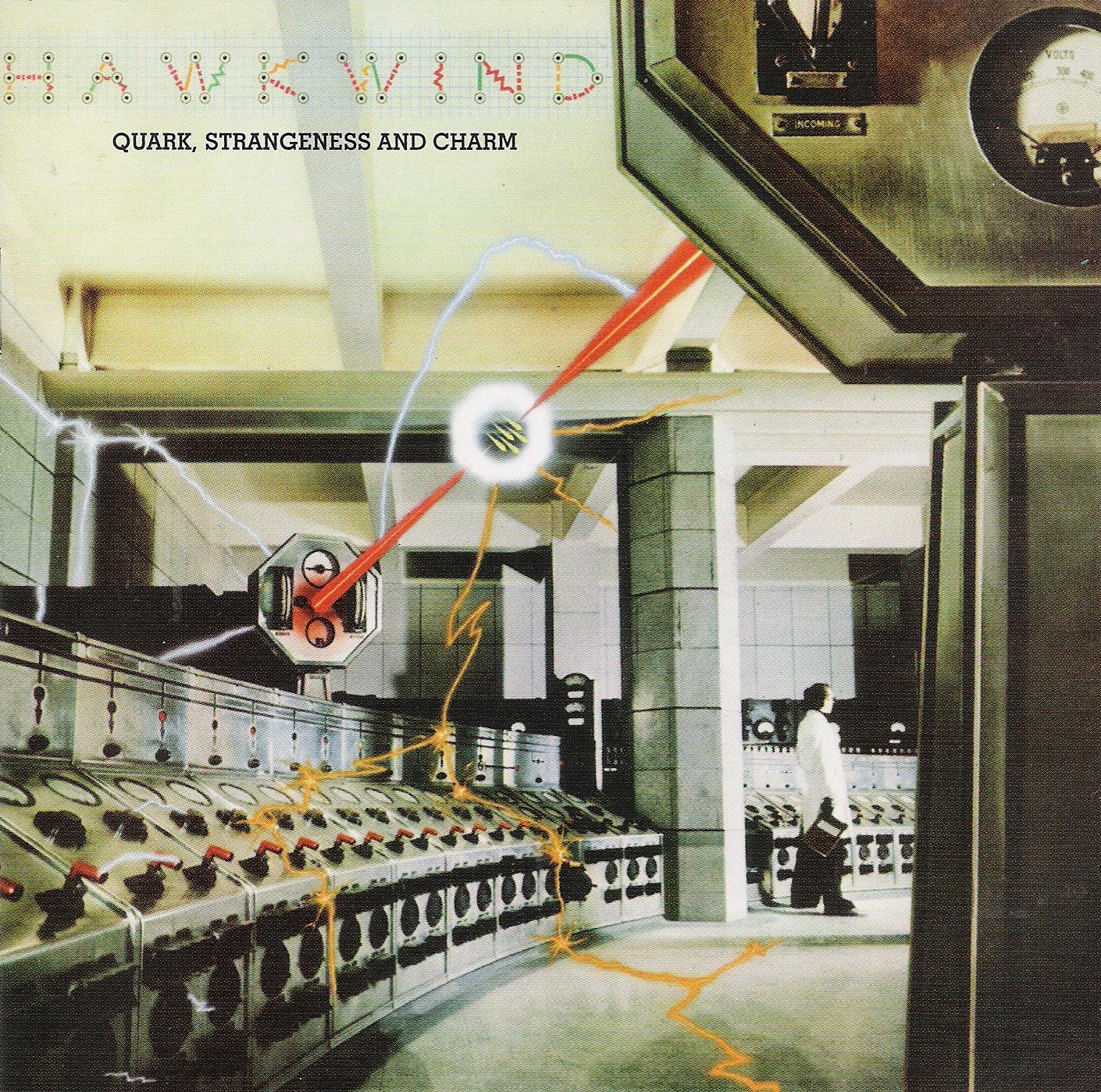
Hawkwind - Quark, Strangeness and Charm (1977)


I heard this very album played in the fifth form common room at school one lunch break thirty or so years ago, which is odd because I have no other memory of there having been a fifth form common room at my school. Similarly mysterious was the identity of the band. I assumed it was probably the Stranglers, although it wasn't a song I recognised and Hugh Cornwell's voice didn't sound quite right even though it was almost certainly him. I was surprised when I saw the cover, knowing Hawkwind to be a bunch of hippies probably sounding a bit like either Pink Floyd or Gong or one of that lot.

I'm kicking myself now of course. I'm not sure why it's taken me so long to get around to this one, although I suppose everything has its time. I probably should have taken the hint back in 2000 when Nigel Ayers of Nocturnal Emissions wrote the following in issue seven of The Sound Projector:

If you look at the whole of that so-called industrial scene from Cabaret Voltaire to Marilyn Manson, the band with the most far reaching influence wouldn't be Throbbing Gristle, but Hawkwind! This is something that they rarely mention in the press, as Hawkwind have this reputation as a British hippie band who do science-fiction and theatrics and therefore must be naff. Whereas if they were a German hippie band... Zoviet France have told me they were very keen on Hawkwind; SPK were well into Hawkwind back in Australia; and what are Graeme Revell and Brian Williams doing nowadays? Making soundtracks for science-fiction films - I rest my case! I think it's about time Hawkwind were reassessed. I have long been tired of those outfits who cite influences no-one has heard of, or can stand listening to. Back in the early seventies, Hawkwind were the first band I was aware of to popularise the idea of sonic attack, infra and ultra sound as a weapon. Listen to Sonic Attack on Space Ritual. That of course has long since been taken up by that whole noise scene, but Hawkwind were rarely acknowledged. If you look at the information war thing, you'll notice that Hawkwind had the post-modern writers, Michael Moorcock and Bob Calvert working with them. Though Moorcock is best known for his very popular science-fiction and fantasy genre work, it's more accurate to call him a postmodernist or at least a modernist. Moorcock pointed many in the direction of William Burroughs and J.G. Ballard and - stone me, he even wrote for Re/Search. When Hawkwind's In Search of Space came out in the early seventies, it came with a booklet of very similar material to what the London Psychogeographical Society, the Association of Autonomous Astronauts, Iain Sinclair, and Tom Vague have been doing more recently. Whenever I used to see Psychic TV, I thought Hawkwind. Whenever I saw Throbbing Gristle I thought Hawkwind without the lights and without the tunes. That combat clothing thing - Hawkwind! Which brings me to the point that I would definitely question the history of punk rock and weirdy music that overlaps it that media hacks have tended to spout. I remember that, apart from media darlings the Sex Pistols, the DIY punk scene in early '70s Britain seemed to be much inspired by the efforts of Hawkwind, the Edgar Broughton Band, the Pink Fairies and even Gong; and the context of the free festivals. Free festival, a self-organising proletarian cultural gathering often involving a bit of a knees up and maybe a punch up with the coppers, see also rave. Brian Eno, for example used to hang out with the Pink Fairies. The whole set-up and costuming of Roxy Music was a direct crib off Hawkwind; AMM - my arse! Eno's a popularist, otherwise why's he working with U2? In 1972 Hawkwind followed up Silver Machine - a million selling hit about a time travel machine built by the pataphysicist Alfred Jarry - with the single Urban Guerilla. It was pulled by the record company because of fears about an IRA bombing campaign in London at the time. They later re-recorded it with Johnny Rotten. Joe Strummer's 101ers and the Stranglers used to play on the same bill as Hawkwind in the free festival days, pre-1976. In interviews at the time, Strummer cited Hawkwind as an influence on the Clash's first album. Pete Shelley of The Buzzcocks admitted he spent a lot of his youth listening to Space Ritual and derived a lot of his musical direction from it; and of course Lemmy of Motorhead used to play bass in Hawkwind. Anyway, I went to see Sun Ra and his Arkestra once and I got bored after twenty minutes of that jazz shite and went home. I've seen Hawkwind loads of times and they rock!

Listening to this now, it's clear that the above is not only on point, but arguably just the tip of the iceberg, even beyond that unearthly electric chug which worked so well for Throbbing Gristle. The fact of post-Britpop Blur sounding a hell of a lot like this album, particularly The Days of the Underground, is probably only great minds thinking alike albeit a couple of decades after the fact; but this is just one of many parallels which seem to difficult to avoid. Case in point being professional industrial music arseholes claiming to have invented acid house or rave, when the established knowledge of who actually innovated such genres isn't negated by their being black guys who never went to art school; but it has to be said that the rave dynamic of extended mesmeric grooves built on riffs of weirdly crunchy sound - guitar in this case - somehow replicating the effect of coming up on a couple of disco biscuits, is very much evident on Quark, Strangeness and Charm. It's a very trippy album - which isn't a word I often use - and euphoric without the usual attendant drippiness of having to put flowers in your hair as you head off in the general direction of San Francisco. Hawkwind were rave before rave, occurring as their own near-autonomous culture in a way which sort of prefigures Crass, amongst others. Yet culturally they have a fiercely urban quality which references mainstream society, as opposed to everything being based on the world as filtered through the spout of a pot of mushroom tea. The lyrics resemble science-fiction, but then science-fiction is as good a metaphor as any for the problems of urban society, and certainly no worse than anything associating lurve with the light of silvery moons.

As with many compact disc reissues, this one is a double disc stuffed with demos, live versions, and so on. Ordinarily this sort of thing annoys the hell out of me. I want the album as it was, a discrete unit of culture with the same beginning, middle, and end, and exclusively comprising the stuff which was considered good enough to release at the time. The worst example of this sort of tendency might be the reissue of Suede's Head Music on three discs including previously unreleased material so dull that I'm surprised even the band would want to hear it ever again - rare out-takes and demos for an album which was actually kind of shit in the first place. Anyway, Quark, Strangeness and Charm turns out to be the opposite of that unfortunate bloating, which is probably testimony to the general quality of Hawkwind as an institution - extras which actually add to the experience. This is a sublime album and I'm definitely going to need more of this stuff.

Thursday, 18 December 2014

Cosmic Rays - Cosmic Rays (2014)


I should probably own up to a certain potential for bias here, having known the drummer of this lot for the best part of the last three decades; so I'm favourably disposed towards their music before I've heard it. At the same time it may be worth pointing out that if it had turned out to be crap, I would probably have found the situation embarrassing and left it at yes, Charlie, it was just the sort of thing I like without bothering to either write or post a review here.

The Charlie in question carries the surname Adlard and will be known to at least some as the artist on, amongst other things, Image's Walking Dead comic. He's joined here by fellow comic artist Phil Winslade, known for various things amongst which was Vertigo's Goddess, as written by Garth Ennis. Wikipedia claims he landed the Goddess gig when he showed the aforementioned Ennis his portfolio at a comic convention in Coventry. Weirdly, I'm pretty sure both Charlie and myself were at that same convention. We too spoke to Garth Ennis - which was quite exciting - and I told him that the tone of Troubled Souls reminded me a little of Harvey Pekar's American Splendor, which he seemed to appreciate. What a weird, small world it has turned out to be.

Anyway, Cosmic Rays are two comic artists and two of their friends. I think the name may have been intended as some sort of vague pun - comic and cosmic - but anyway...

For the record, Charlie was a phenomenal drummer even back when his drawing ability was more village fête than Eisner Award, so it wouldn't really be fair to call this a vanity project, should one be tempted to do so; and it certainly doesn't sound like one. What it does sound like is heavy rock - as quite distinct from metal - which acknowledges no strong musical influence of anything since about March 1982. I picked that particular date because that was when Iron Maiden released The Number of the Beast, and my initial impression of the Cosmic Rays album leant in that general direction mainly thanks to the histrionics of the two opening tracks. Closer and repeat listening reveals this comparison to be pretty flimsy, not least because whilst there's neither rapping, drum and bass remixes, nor anything which would startle Tommy Saxondale to any great extent, Cosmic Rays manages to avoid sounding like an exercise in nostalgia, working perfectly well as its own entity. There are moments I'm reminded of the Who or maybe the Kinks, and there's Shoes which could have been recorded by one of the bluesier incarnations of Jim Thirlwell's Foetus, but there are too many individual subtle touches which dispel such comparisons, too much which varies from the standard rock template - the buzzing fuzz of the bass, the ornate keyboard noodling, and sharp as a knife production which keeps even the noisier flourishes sounding clear as a bell and definitively stamps the collection as belonging right here in the twenty-first century. The closest I've been able to get to any sort of general comparison is that I can imagine a lot of these songs being performed by the Black and White era Stranglers, which is odd as Cosmic Rays sound nothing like the Stranglers, so I suppose it's some subtlety of chord changes or composition or the general vibe - a sort of pulsing black leather Englishness for want of a less comical simile.

Having known Charlie for a while, and enjoyed at least one of the previous bands for which he bashed the skins, so to speak, I knew this was never going to be terrible; but it's a pleasant surprise how genuinely good it is, and how fresh it sounds for something which could be considered a fairly traditional rock album in many senses. May this be but the first of many.

Available here and now in a lovely double vinyl edition too.