Showing posts with label Motorhead. Show all posts

Tuesday, 24 March 2026

Bolt Thrower - Realm of Chaos (1989)


I'm not sure it's even possible for me to be any further out of my depth than with this one. I hated metal, or what was then called metal, for most of my formative years. I hated the silly logos of chrome-plated skulls embellished with either Old English or piles of twigs. I hated the pantomime scary faces pulled on stage and record covers. I hated the lyrics endlessly referencing the dullest shite known to mankind - crap horror movies, Lord of the Rings, Dungeons & fucking Dragons. I hated the guitar solos. Napalm Death always sounded like a fucking racket to me, and while I was already listening to a lot of music which revelled in being a fucking racket, it was usually an interesting fucking racket, not just Motorhead played at 750mph with the Cookie Monster barking lyrically on the subject of Cthulhu over machine gun bass pedals. Despite hailing from Coventry, a city in which I have resided at various points, Bolt Thrower naturally passed me by.

As with many things I initially dislike, I eventually came to wonder whether I really disliked Bolt Thrower, and if so what it was that I found specifically annoying. It somehow took me three decades to overcome this one, but never mind. I had a listen to summat on YouTube and it gripped me with a Hadrian's Wall of the dirtiest, thickest guitar distortion you ever heard and drums pounding at the pace of a funeral.

'Yoink,' I yelped as I leapt from my seat, 'I must own this record!' I looked in a few of the usual online places and found that this, their first album, was long out of print and therefore prohibitively expensive if you could even find a copy. Another five years passed and suddenly there was a reissue sat in the racks of Hogwild Records. I got it home and was disconcerted to discover that  it sounded quite different to whatever I'd heard on YouTube, and that I'd actually made purchase of one of those Cookie Monster records I've been avoiding for more or less the entirety of my life.

Assuming I was mistakenly remembering something by the Melvins, or Eyehategod, or one of those other admittedly listenable bands, I gave Realm of Chaos a spin anyway. I couldn't figure the fucker out, so I gave it another spin. Why would anyone record this?, I asked myself, and kept playing it because I felt I should at least make the effort to understand. Eventually, probably inevitably, if it still didn't make sense, I could at least appreciate it as a mammoth slab of black vomiting from my speakers for forty minutes or so. The bass pedal came to sound more like a synth growl, and the wall of guitar drops chords like slabs of meat onto a mortuary floor, and even if I remained fully confused, it sounded like Bolt Thrower knew exactly what the fuck they were doing - which is probably all you need; although it possibly helps that there's a track called World Eater, which is the sort of title that predisposes me to enjoy whatever the hell it is before I've heard a note. Thankfully it wasn't zydeco.

So Realm of Chaos is what the first four Black Sabbath albums sound like after they've been through a black hole, or something - so vast it's not even possible to tell how big it really is and - on close inspection - just a few steps along the evolutionary ladder from the stuff I recognise as music. Yet this also is music, just a bit darker.

Sometimes it's nice to discover just how wrong you can be.

Monday, 2 September 2024

Hope + VX - Kilo Price for Dead Shapes (2024)


As my Peter Hope albums multiply to the point of requiring their own shelf, here's another which somehow manages to sound like a new direction despite delivering a blast of familiar intensity with weapons from the same sonic arsenal. The distortion is, as ever, incredible, hinting at things recorded on the condenser mics of mono portable cassette recorders blowing the transistors on an ancient fuzz box someone found in the outside toilet; and yet despite this wall of audio dirt, everything remains somehow sufficiently clear and distinct for a groove. I should probably make an effort to avoid the usual comparisons with Suicide, Chrome and the like, although it may be worth mentioning that you could probably stick it at the bluesier end of the Sleaford Mods spectrum without too many objections. It doesn't really sound like Hope's Exploding Mind, or his work with Fujiyama or David Harrow, but it inhabits the same universe.

This time it's one Neil Whitehead, recording as VX, providing the contrast with, I would guess, loops of the sort of drum kit you only ever encountered in village halls when you were a teenager - all the crash and clang of the cutlery drawer - and a shitload of distorted bass guitar hogging the rest of the bandwidth, and I suspect multitracked in a few instances; so it's possibly comparable to an angrier We Be Echo - specifically the current bass heavy version - or if We Be Echo had the impact of Motorhead, it would feel something like this. The fact of there still being someone alive who would produce a record that sounds like this gives me some hope for the future of the human race.

Thursday, 11 February 2016

David Bowie - Blackstar (2016)


Major fluctuations in the fabric of the Spectacle often tend to bring forth a plague of boils, and boils need lancing, so you might want to skip the first couple of paragraphs.

There's a book called You and Who in which fans of Doctor Who wax lyrically about their favourite show, which is nice because as we know it can be a tough job coaxing these ordinarily reticent, some might say monastic individuals into sharing their opinions; and the same publisher is soon to bring us a similar volume in memoriam of David Bowie, the late chameleon of reinvention. I have seen it opined of Bowie's career that it was almost like he was getting Doctor Who to take him forward a couple of years in time in the TARDIS to check out what was going down in the future whenever he recorded a new album, so it makes sense when you think about it. Thusly I'm really looking forward to a big fat volume of essays on how Bowie's ever-shifting personas were a bit like all the different incarnations of Doctor Who, and how listening to Never Let Me Down got us through some tough times at uni, and how the influence of the self-styled chameleon of reinvention can be heard in everything from Curiosity Killed the Cat to the Jo-Boxers. It's going to be fantastic.

I am dubious of the ways in which we've all marvelled at Bowie's constantly morphing into something new like a rock 'n' roll Barbapapa being genuinely akin to what happens when you go back in time with Doctor Who in his amazing TARDIS and play a tune on your iPhone to a horde of boggle-eyed mediaeval serfs just before they put you on trial for witchcraft. It's not so much that Bowie kept on transforming into something the like of which we'd never seen before as that he wasn't simply re-recording the same album over and over, and in the seventies this seemed like a new thing. The Beatles did it, but I suppose we assumed they were an exception because they were the Beatles. Still, I suppose we're going to be hearing a lot about the fluid state of the ever-changing chameleon of reinvention over the next few months, along with Porridge finally breaking his silence on that band which he and Dave were going to form but never quite got around to - which I'm guessing will be sometime in April.

It has been pointed out somewhere or other that Bowie was not so much a chameleon as a magpie, an artist who popularised his influences, which if nothing else at least saves us the trouble of having to listen to the Velvet Underground. Blues & Soul magazine described him as an artist whose career was entirely based upon the wholesale plunder of black music, which was the point at which I stopped bothering to read Blues & Soul. You might just as well describe rap as a genre entirely based on the wholesale plunder of  white music because of that Kraftwerk 12" single.

The truth is probably in there somewhere. As a massive generalisation, my take on it is that regardless of who Bowie may or may not have ripped off, he popularised pop as an art form of arguably equivalent value to painting, sculpture, Cubism, Jackson Pollock or whatever reference works best for you. This isn't to say that he was the first so much as that he was the first to sell shitloads of records doing so, and to sell them to people who didn't really give a shit about Andy Warhol or William Burroughs.

I don't know. Who cares?

I liked the Beatles when I was a kid. I had four of their albums because they made children's music. Their music was plenty of other things too, but to me it was that and sort of still is. The next record I bought was either by Devo or David Bowie, and I can no longer remember which came first. I must have been about fourteen. I'd been playing those four Beatles albums over and over for about five years when Graham Pierce lent me the first Devo album. It sounded weird and freakish and I didn't even want the thing in my home. I tried to give it back but Graham told me to stick with it, so I did, and realised that I liked it. Either just before or just after my conversion to Devo, Jason Roberts lent me Hunky Dory. I hadn't expressed any interest in Bowie, but Jason seemed to think that I needed to hear the guy. I couldn't even work out why he should have thought that, but I played the album and loved it, and within about a year I had two Devo albums and most of what Bowie had released up to that point; and I never really went back to the Beatles.

Bowie was therefore a massive part of my childhood, and a formative influence on my interest in music, which is probably why it hurt so much that his music became so crappy so soon after I discovered it. I bought Scary Monsters when it came out, and it was a great album, but it was downhill from thereon. He became a Phil Cornwell impersonation throwing self-consciously weird shapes for the sake of it, and he did that for nearly thirty years. It felt as though he'd lost his way, a hunch seemingly supported by this observation made on facebook by Johnny Riggs, who had the pleasure of interviewing the man a couple of times:


But past [Scary Monsters] I think he's been scrambling for a style and a sound (and working in radio I met people who worked with him in the studio who said that was pretty much true) and he hasn't made any music of interest until the last couple of records. Output like Black Tie, Earthling, Outside, etc., I just pretend [it] doesn't exist. It makes me feel better about him. When I read words of praise about them I get confused.

I bought the single Let's Dance when it came out, and it still sounds great, but that was pretty much the last good thing for a while. Black Tie White Noise was hailed as a true return to form, although the singles didn't seem to back that up, at least not for me, and when I eventually heard the thing I thought it sounded fucking comical, and have tended to distrust the claim of a true return to form which has greeted each new Bowie album since then. Maybe as the eighties came around, confronted with a thousand younger versions of his previous records, our Dave felt he'd painted himself into a corner; or he just wanted to be loved again, and loved without inspiring anyone to write essays on Situationism or Jasper Johns; or maybe there was nothing he liked enough to consider worth ripping off. Whatever the case, Bowie was over so far as I could see, and exceptions to the rule were just that, hence Little Wonder.

Anyway, last week I listened to a bit of The Next Day on YouTube just for a chuckle and realised it was the first Bowie I'd been able to listen to since Scary Monsters without picturing Phil Cornwell presenting John Sessions with a facecloth on Stella Street. In fact it reminded me of how exciting it used to be buying a new Bowie album and rushing home to give it a listen. So I went to Hogwild and bagged the new one, and weirdly it really was great,  although it sounded suspiciously like a farewell record, the work of someone who knew the game was up; and now he's no longer with us. I was still getting used to the idea of a David Bowie once again making real music, when suddenly I found I would additionally have to get used to the idea of a past tense David Bowie, which seemed pretty rotten.

Working with a model of Bowie's back catalogue ignoring everything I haven't heard occurring between now and the final album he recorded for RCA, this one reminds me of Station to Station in terms of mood - that being his other lowest introspective ebb record, I suppose - and also Low and Heroes in terms of that pounding percussion, which is probably Tony Visconti as much as anything; and yet it has an identity of its own, whilst almost any track on here could have appeared on Diamond Dogs, Space Oddity, or any of the others without sounding too greatly out of sequence. It has a faintly jazzy sound without quite resembling jazz, which would be the horns and the percussion bordering on the more organic strains of drum and bass. I guess in the lazy terms of the chameleon of reinvention, we've had hippy Bowie, glam Bowie, depressed Bowie, and this would be terminal cancer Bowie. Specifically it sounds like a farewell, and it doesn't require too much imagination to deduce what any of these songs are about. He's here, and he knows it won't be for long, and this is how it feels; or felt.

It makes for tough listening, particularly Lazarus and the fucking racket of Sue (or in a Season of Crime) with its references to clinics and x-rays and stifled hopes; and yet it ends on the incongruously uptempo, almost philosophical note of I Can't Give Everything Away. It's saying things which aren't quite communicated by words alone - which is of course why it's a music album rather than merely an essay; which I suppose has always been the key to Bowie's appeal, namely the poetry of what is said rather than whether or not he's channelling Lou Reed or Iggy Pop or whoever. It comes just as we've lost Lemmy, Mark B, Alan Rickman, and as two of my virtual acquaintances have lost dear friends, and as another close friend's mother has been diagnosed as having about three weeks left, so I suppose you could say it is unfortunately and horribly timely.

It has been wonderful to have our David Bowie back after all this time, even if it wasn't for very long.

Fuck.

Bollocks.

Also shit.

Thursday, 31 December 2015

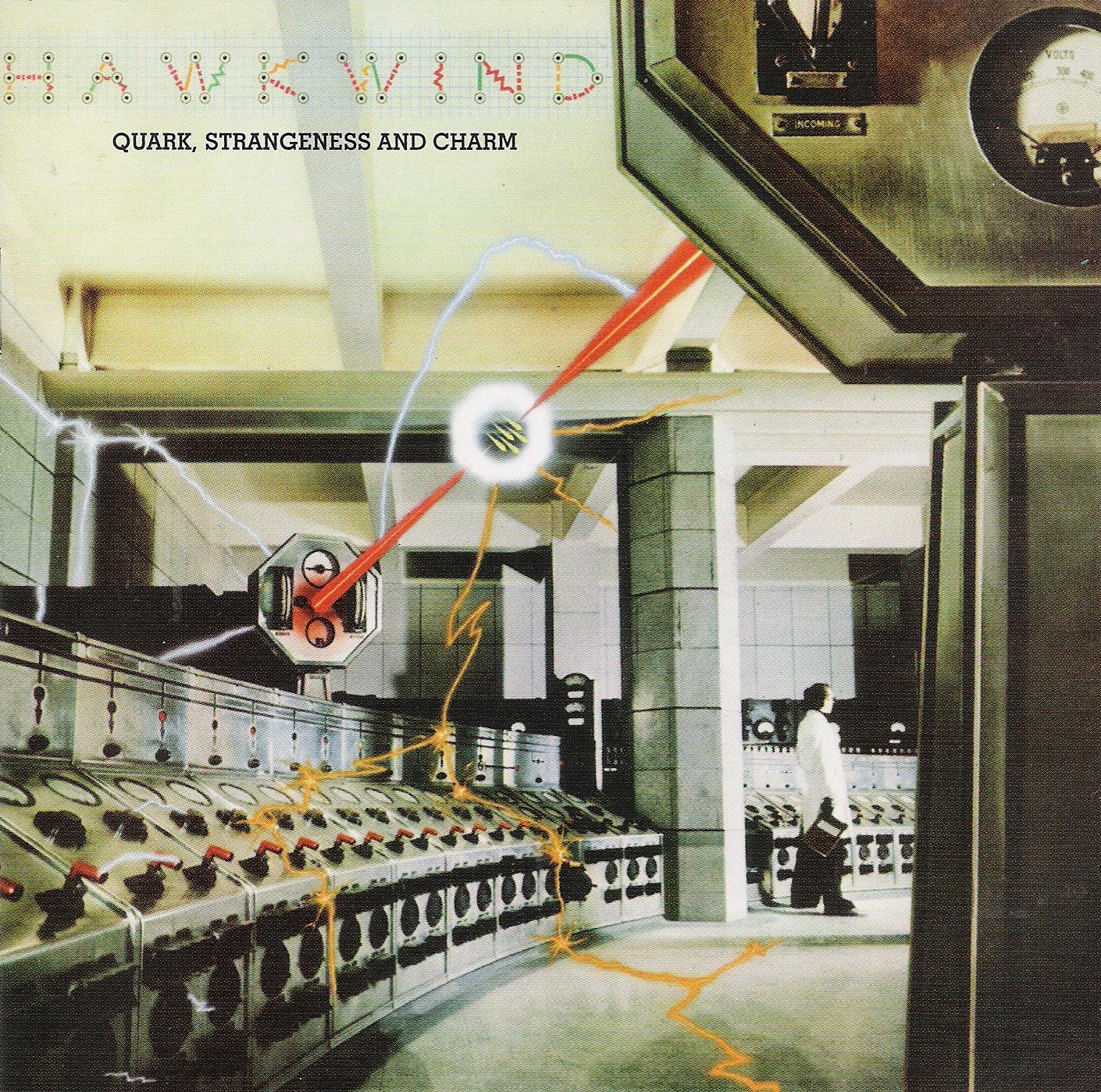
Hawkwind - Quark, Strangeness and Charm (1977)


I heard this very album played in the fifth form common room at school one lunch break thirty or so years ago, which is odd because I have no other memory of there having been a fifth form common room at my school. Similarly mysterious was the identity of the band. I assumed it was probably the Stranglers, although it wasn't a song I recognised and Hugh Cornwell's voice didn't sound quite right even though it was almost certainly him. I was surprised when I saw the cover, knowing Hawkwind to be a bunch of hippies probably sounding a bit like either Pink Floyd or Gong or one of that lot.

I'm kicking myself now of course. I'm not sure why it's taken me so long to get around to this one, although I suppose everything has its time. I probably should have taken the hint back in 2000 when Nigel Ayers of Nocturnal Emissions wrote the following in issue seven of The Sound Projector:

If you look at the whole of that so-called industrial scene from Cabaret Voltaire to Marilyn Manson, the band with the most far reaching influence wouldn't be Throbbing Gristle, but Hawkwind! This is something that they rarely mention in the press, as Hawkwind have this reputation as a British hippie band who do science-fiction and theatrics and therefore must be naff. Whereas if they were a German hippie band... Zoviet France have told me they were very keen on Hawkwind; SPK were well into Hawkwind back in Australia; and what are Graeme Revell and Brian Williams doing nowadays? Making soundtracks for science-fiction films - I rest my case! I think it's about time Hawkwind were reassessed. I have long been tired of those outfits who cite influences no-one has heard of, or can stand listening to. Back in the early seventies, Hawkwind were the first band I was aware of to popularise the idea of sonic attack, infra and ultra sound as a weapon. Listen to Sonic Attack on Space Ritual. That of course has long since been taken up by that whole noise scene, but Hawkwind were rarely acknowledged. If you look at the information war thing, you'll notice that Hawkwind had the post-modern writers, Michael Moorcock and Bob Calvert working with them. Though Moorcock is best known for his very popular science-fiction and fantasy genre work, it's more accurate to call him a postmodernist or at least a modernist. Moorcock pointed many in the direction of William Burroughs and J.G. Ballard and - stone me, he even wrote for Re/Search. When Hawkwind's In Search of Space came out in the early seventies, it came with a booklet of very similar material to what the London Psychogeographical Society, the Association of Autonomous Astronauts, Iain Sinclair, and Tom Vague have been doing more recently. Whenever I used to see Psychic TV, I thought Hawkwind. Whenever I saw Throbbing Gristle I thought Hawkwind without the lights and without the tunes. That combat clothing thing - Hawkwind! Which brings me to the point that I would definitely question the history of punk rock and weirdy music that overlaps it that media hacks have tended to spout. I remember that, apart from media darlings the Sex Pistols, the DIY punk scene in early '70s Britain seemed to be much inspired by the efforts of Hawkwind, the Edgar Broughton Band, the Pink Fairies and even Gong; and the context of the free festivals. Free festival, a self-organising proletarian cultural gathering often involving a bit of a knees up and maybe a punch up with the coppers, see also rave. Brian Eno, for example used to hang out with the Pink Fairies. The whole set-up and costuming of Roxy Music was a direct crib off Hawkwind; AMM - my arse! Eno's a popularist, otherwise why's he working with U2? In 1972 Hawkwind followed up Silver Machine - a million selling hit about a time travel machine built by the pataphysicist Alfred Jarry - with the single Urban Guerilla. It was pulled by the record company because of fears about an IRA bombing campaign in London at the time. They later re-recorded it with Johnny Rotten. Joe Strummer's 101ers and the Stranglers used to play on the same bill as Hawkwind in the free festival days, pre-1976. In interviews at the time, Strummer cited Hawkwind as an influence on the Clash's first album. Pete Shelley of The Buzzcocks admitted he spent a lot of his youth listening to Space Ritual and derived a lot of his musical direction from it; and of course Lemmy of Motorhead used to play bass in Hawkwind. Anyway, I went to see Sun Ra and his Arkestra once and I got bored after twenty minutes of that jazz shite and went home. I've seen Hawkwind loads of times and they rock!

Listening to this now, it's clear that the above is not only on point, but arguably just the tip of the iceberg, even beyond that unearthly electric chug which worked so well for Throbbing Gristle. The fact of post-Britpop Blur sounding a hell of a lot like this album, particularly The Days of the Underground, is probably only great minds thinking alike albeit a couple of decades after the fact; but this is just one of many parallels which seem to difficult to avoid. Case in point being professional industrial music arseholes claiming to have invented acid house or rave, when the established knowledge of who actually innovated such genres isn't negated by their being black guys who never went to art school; but it has to be said that the rave dynamic of extended mesmeric grooves built on riffs of weirdly crunchy sound - guitar in this case - somehow replicating the effect of coming up on a couple of disco biscuits, is very much evident on Quark, Strangeness and Charm. It's a very trippy album - which isn't a word I often use - and euphoric without the usual attendant drippiness of having to put flowers in your hair as you head off in the general direction of San Francisco. Hawkwind were rave before rave, occurring as their own near-autonomous culture in a way which sort of prefigures Crass, amongst others. Yet culturally they have a fiercely urban quality which references mainstream society, as opposed to everything being based on the world as filtered through the spout of a pot of mushroom tea. The lyrics resemble science-fiction, but then science-fiction is as good a metaphor as any for the problems of urban society, and certainly no worse than anything associating lurve with the light of silvery moons.

As with many compact disc reissues, this one is a double disc stuffed with demos, live versions, and so on. Ordinarily this sort of thing annoys the hell out of me. I want the album as it was, a discrete unit of culture with the same beginning, middle, and end, and exclusively comprising the stuff which was considered good enough to release at the time. The worst example of this sort of tendency might be the reissue of Suede's Head Music on three discs including previously unreleased material so dull that I'm surprised even the band would want to hear it ever again - rare out-takes and demos for an album which was actually kind of shit in the first place. Anyway, Quark, Strangeness and Charm turns out to be the opposite of that unfortunate bloating, which is probably testimony to the general quality of Hawkwind as an institution - extras which actually add to the experience. This is a sublime album and I'm definitely going to need more of this stuff.

Thursday, 17 October 2013

Revolting Cocks - Big Sexy Land (1986)


I liked the idea of this band, if you could really call some guy hanging around in a studio with his mates a band. After all, there was the determinedly offensive name, and the involvement of at least two members of the greatly superior Front 242, and that they were obviously all just having a laugh; and of course Stainless Steel Providers was possibly the greatest single to ever feature a two-note bassline; but I found myself hugely disappointed that the Cocks didn't turn out to be those three shifty looking chaps they always had on their record sleeves, but were another one of those horrible industrial supergroups who, much like Journey, Pigface and the Traveling Wilburys, worked by the flawed premise that if you get enough famous people together in the same place, awesomeness will surely come to pass. I've never bought into the idea myself. It smacks too much of wouldn't it be amazing if they had Spiderman in an episode of Star Trek?

Whilst I would hardly wish to imply that Alain Jourgensen - the Jeff Lynne of Revolting Cocks - is in any sense bereft of talent, mainly because I thought Lard and Pailhead were decent enough, there looks to be an awful lot of poop in his back catalogue from where I'm standing.

Ministry were Depeche Mode who wished they'd ticked the box marked Slayer, and that was on their good days; the group who daringly brought caged titty dancing and rubbish tattoos back to rock because that's what we really needed - Whitesnake with a fucking synthesiser, although maybe not quite so poetic seeing as Ministry were seemingly aimed at people who hadn't cottoned on to Spinal Tap being a comedy. We already had Motorhead. We didn't need a version that was safe for consumption by fans of Psychic TV.

Of course, it has been said that Ministry's Twitch album was a significant influence on both Nine Inch Nails and everybody else, ever - although I've noticed this is said mostly in YouTube comments so I'm not sure if that counts, particularly as Twitch owes one hell of a debt to its producer Adrian Sherwood, as does much of the first Nine Inch Nails album; and the bottom line for me is that one of Jourgensen's four billion side projects was called Buck Satan and the 666 Shooters - I mean seriously?

How old was he at the time?

Twelve?

Okay Al, you're one scary guy and we're all terrified. You don't like going to church, but you do like to drink beer and watch bare breasts jiggling up and down. We get it now.

So maybe it isn't all the work of a gurning manchild pulling scary faces and saying ooga booga hail Satan to his mum, but mostly...

Big Sexy Land isn't terrible, but it's pretty damned average - distorted drum machine, noise, someone grunting the usual bad guy stuff in the hope of fostering tedious ambiguity regarding whether the song expresses condemnation or approval of death, murder, and stubbing your big toe; and the usual routinely shocking samples deployed in the usual way - tattoed penis tattooed penis tattatattatattatattatattoed penis, and I know it was 1986, but I was there too, and this sort of crap sounded balls-achingly obvious even then. The only element missing is the obligatory tribute to Charles Manson.

Perhaps through being no stranger to the business end of a drum machine, the problem is that I've done this sort of thing myself so I know how easy it is; but usually you return to your monsterpiece three days later and record something less predictable over it rather than slap it on an album and flog it to people.

To be honest, it's possibly not even the fact of Big Sexy Land being such a complete waste of time that bugs me so much as all those gibbering industrial rock baboons who seem to believe that Jourgensen invented bad-ass, plus paying three dollars for this at CD Exchange and still feeling like I've been diddled. I was expecting at least a few chuckles.