The Bone Orchestra involved Charlie Collins and Peter Hope, both formerly of the Box, along with a number of other Sheffield luminaries - not least being a full horn section - and existed in the gaps between musical endeavours which the rest of us are probably more likely to remember. When Will the Blues Leave? was recorded on four track - and mostly live by the sound of it - originally issued on cassette, and really should have been snapped up by some record label and flogged to the point of it being embarrassing back in 1987; which it wasn't because who fucking knows? My guess would be that quality doesn't always receive the recognition it is due.
The songs are some sort of bluesy semi-Brechtian cabaret hybrid suggestive of bars where dreams go to drink themselves into a coma, occupying a stylistic spectrum which flies off in all directions without necessarily sounding schizophrenic, or at least not in the musical sense. The percussion section borrows from either the kitchen or the junkyard, the bass prowls, Charlie Collins honks, hoots and even squeezes an accordion, and Hope channels his demons, some familiar and a few we've never met before - switching from growl to heroic croon to almost Noel Coward on Horse, for example - the one track which reminds me of the Box, for what it may be worth.
I realise it's hopelessly lazy to make comparisons with other artists, but can be difficult to avoid where a blues influence is so pronounced given the spread and extent of the form; but to get it out of the way, When Will the Blues Leave? probably inhabits a building a few blocks along from Nick Cave, Tom Waits, and the Tiger Lillies amongst others. On the other hand, Quick Money reminds me of West African pop music* of all things. In fact, the whole wouldn't have sounded out of place issued on Billy Childish's Hangman label back when he first started hammering out those monthly albums - notably the Black Hands' Capt. Calypso's Hoodoo Party. I'm not sure there's specifically a standout track given the general level of intensity maintained more or less for the duration, but it has to be said, No New Leaves is in particular fucking incredible.
*: I'm thinking of The Vodoun Effect by Orchestre Poly-Rythmo de Cotonou.
Wednesday, 3 November 2021
The Bone Orchestra - When Will the Blues Leave? (1987)
Wednesday, 4 August 2021
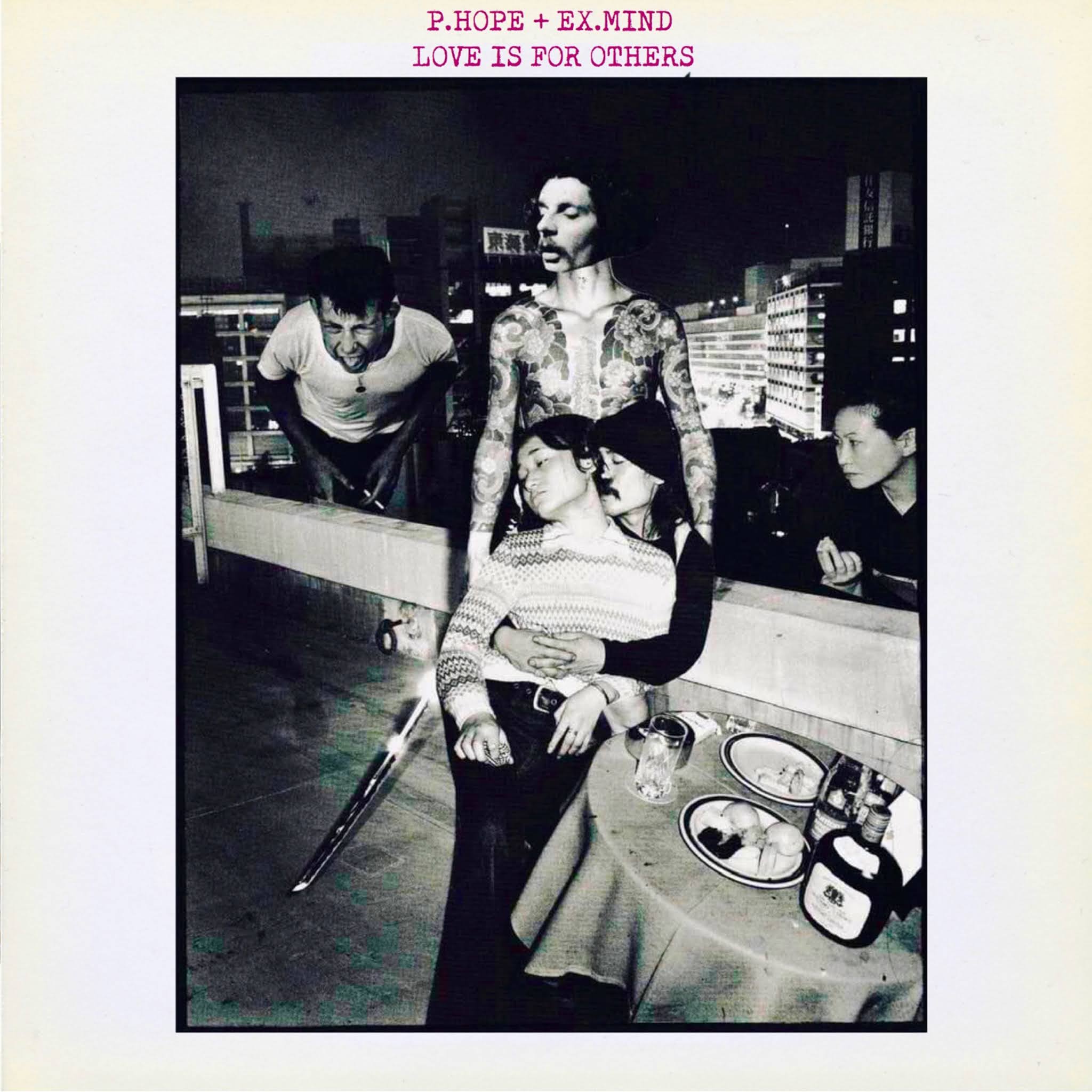
Peter Hope & the Exploding Mind - Love is for Others (2021)
Peter Hope records under many names depending on the general thrust of the material, and this latest expression of the Exploding Mind seems to represent a convergence of all the different strands, bolting the gonzo electronics of No Scene, or even the Hot Crow on the Wrong Hand Side album, to the dirty acid of pH2. Obviously this won't make any fucking sense whatsoever unless you're already familiar with a few of these names, so let's start at the beginning.
Older boys and girls may recall Hope as vocalist for the Box and therefore part of that whole Sheffield scene. He's worked with Richard H. Kirk. In fact he seems to have worked with pretty much everyone at some point, and now he lives and records in a seemingly wild corner of New Zealand, at least judging by the photographs. The photographs in question often seem to feature himself building things out of massive rocks with his own bare hands, walls and possibly even his actual house; or this could simply be an impression I've picked up from the music, because it doesn't sound like the work of someone who fears either wilderness or the sort of tough, gut-busting labour necessary for carving out an existence therein. Love is for Others, wherein Hope collaborates with Toby Barrow, is mostly electronic - excepting, I suppose, the heavily treated vocals - but it somehow doesn't feel it, or at least it doesn't feel like anything politely composed on a screen. The rhythms, if clearly originated from some box or other, resemble a cargo cult version of techno formed from rocks, wood, and bits of metal smashed together - programmed with dirt under the fingernails. Everything is overdriven or distorted without turning into either death metal or power electronics, somehow retaining enough of an identity to reveal distant roots in acid house - and so much so as to allow for contributions from the characteristically excellent Mrs. Dink without anything sticking out, if you'll pardon the expression.
If it's still unclear what I'm talking about, I suppose we could call it modern blues via Suicide, or maybe even Chrome, nailed to a rough as fuck acid beat and probably recorded far too loud, which is why it works so well. There's nothing clean here, and it's sort of the opposite of vapourwave in that respect, but better than I've probably made that sound. I've always thought the traditional inducement to play it loud, as often featured on the gramophone recordings of my increasingly distant youth seemed something of an overcompensation, but it would be justified with this one which is nothing if not a proper window rattler, and should be appreciated as such.
Wednesday, 31 January 2018
pH2 - Gut Acid (2017)
For the sake of argument, let's assume our understanding of music works like language. You're born, you learn to make noises, you learn to imitate words and phrases, and eventually you learn what they mean and are hopefully able to arrange them in sequences of your own composition. I say hopefully because I'm not convinced everyone gets all the way with that last stage, and some seem to be stalled, having no need to express anything much beyond what they can say with a few stock phrases; and so it is with music, which is why there will always be artists who sound more like tribute acts than anything in their own right. It's easy enough to work out why such and such a piece of music has a certain sound, and how to duplicate it, and that's what most people tend to do.
Peter Hope, on the other hand, seems to have a particular insight in so much as that first and foremost he understands what music does, how it works, even before we've got to the instrumentation or the notes. Both Hot Crow on the Wrong Hand Side and Destroy Before Leaving had pure strains of blues and even jazz running through their DNA without necessarily imitating anything; and now there's Gut Acid, another wild tangent spun from a similar understanding, albeit an understanding of something completely removed from pastures in which the Box or Exploding Mind did their thing. As I understand it, Gut Acid came in part from tracks issued as Criminal Face and originally recorded at the height of acid house at the tail end of the eighties, along with more recent material expanding on the same in collaboration with DJ Parrot and David Harrow. So it's vintage material, or in the spirit of vintage material, or possibly both, but the important thing is that it sounds fucking great right now.
In the wake of acid house, as it all turned to techno or went Balearic or whatever, the bargain bins filled with failed acid, records which missed the target because they'd never quite understood what they were trying to do in the first place, imitating a sound and in imitating it, somehow ending up resembling one of those fucking awful 12" extended mixes some Trevor Horn impersonator routinely pooped out for every shit band going. The lesson in this was that not anyone could cut a dance record after all, and certainly not acid house. Gut Acid uses a few of the same boxes you may recall from Phuture and those guys, and there's the occasional non-tune representing the equivalent of a keyboard smash on a Roland TB303, but as with Hope's other efforts, this is a long way from the methodology of Noel Gallagher pretending to be a Beatle, and there is a lot here which you won't have heard before; but what he duplicates, and which he gets absolutely spot on is the feel of acid, the spirit, the euphoric bubble up and surge seasoned with a hint of something dark. These eight tracks pound and hypnotise, inviting even the most sober and drug free amongst us to concentrate on mesmeric glitches and details.
I'd say more but there's only so much point to writing about music, and I don't want to turn into Paul Morley; besides which Gut Acid is one which really speaks for itself, and it's only a few quid so you should probably give it a listen.
Wednesday, 26 July 2017
Hula - Threshold (1987)
Sounds like Nine Inch Nails, suggested the handwritten sticker hopefully as I picked this from the bin at a record fair, specifically a record fair in Texas which, as you will notice if you consult a map, is quite a distance from Sheffield. It doesn't sound like Nine Inch Nails, but I suppose it sounds more like Nine Inch Nails than it sounds like George Strait, so whatever.
Hula somehow passed me by, although I always had at least a little curiosity given the presence of the bloke who bashed the skins on all those Cabaret Voltaire records. I saw Hula albums in the racks, but there was always something else I wanted more. Online wisdom seems to suggest that they were amazing live but the albums were weird and disappointing, although some of the singles were pretty good; and happily it turns out that Threshold is a singles compilation.
Hula sound roughly like I expected them to, being very much of their time and place, namely Sheffield during the second half of the eighties. There's the drum machine - a Yamaha RX15 I'd guess - pounding out its cold climate equivalent of a b-boy rhythm; and there's the slap bass, horn stabs, flat tops and crew cuts, sweaty young men grunting and frowning in those vests everyone used to wear. You can almost see the video as you listen, somewhere dark with chains hanging down, maybe some sparks flying and a whole lot of funky grimacing. It's the most eighties thing I've heard since the eighties, except even as I formulate the thought, I realise how unfair it is. Hula only sound so firmly cemented into their era because of the distance between now and then, and how record production has changed, not even necessarily for the better; and it doesn't even make sense when you consider that what replaced this sound was mostly jangly arseholes trying to recreate the sixties.
So I gave Threshold a few more spins than I might usually have done, mainly just to reacquaint myself with what all those college discos I always fucking hated used to sound like in between the obligatory bursts of James Brown and Smalltown Boy. It takes some doing, but it's worth it. Once you're past all the reverb on the snare and those congas pinging away in the left channel, distinguishing features begin to emerge - and lest we either forget or hadn't realised in the first place, Hula incorporated members of Clock DVA, the Box, and Chakk, so it's not unreasonable to expect at least some distinguishing features. Twenty or thirty spins down the line and it still sounds like a cross between at least two of the marginally more famous bands already invoked, and yet somehow they get away with it by virtue of just how hard those boys were straining and sweating at their instruments, and they get away with it because there's something brooding, genuinely soulful, and even jazzy buried beneath the pounding rhythms, particularly with Get the Habit and Black Wall Blue.
I'd say there used to be a lot of music which sounded like this, but it's an illusion of memory and not entirely true, because most of those cooking to this recipe usually sounded like Pop Will Eat Itself and were thus a complete waste of everyone's time. Hula were one of the few acts who got it right. Thirty years later, this still holds surprises.
Wednesday, 9 November 2016
Peter Hope & Charlie Collins - Destroy Before Leaving (2016)
This is another one of those download things which exists only as electric magic. I downloaded a couple by Blank Banshee last week and told myself I wasn't going to make a habit of owning stuff with no physical dimensions, but fuck it - it's Peter Hope and it was a quid - actually it was free but it seemed polite to make some sort of donation. Anyway...
Peter Hope and Charlie Collins will of course be remembered as vocals and saxomophone of the Box, who were in turn Clock DVA minus Adi Newton and somehow wound much tighter. You can still feel some of that legacy in these six tracks - dark, dirty, and kind of jazzy without any of the usual unfortunate connotations which have adhered to jazz since it was assimilated by the man. That said, it doesn't exactly sound like jazz beyond the noodling presence of whatever Collins is playing - some sax, some clarinet I think - and a few details of mood. On the other hand, what it very much does sound like is twenty-first century blues, meaning the genuine Robert Johnson deal updated as is appropriate to time and culture, as distinct from some Mark Knopfler heritage project; also as distinct from certain Foetus efforts inhabiting similar territory but sounding a great deal more mannered and studied than this raw outburst of noise, gravel and loathing. Were time travel a thing, you could take this back to the Mississippi Delta in the thirties and I'm pretty sure those guys would recognise it immediately. Of course, beyond Hope's characteristic growl and Collins' riffing, what you have might almost be Einstürzende Neubauten in sonic terms, but it should probably be remembered that whilst the original bluesmen had guitars and harmonicas, they really weren't in the business of making pretty music. So to dispense with most of this paragraph, Destroy Before Leaving is a blues album, and a powerful one, and that's everything you need to know.
Thursday, 5 March 2015
Peter Hope & the Exploding Mind - Hot Crow on the Wrong Hand Side (2015)
Older readers may recall Peter Hope as the tonsils of the Box, one of Sheffield's numerous finest, and this came my way specifically due to my having written about The Box @Doublevision a few months back, which is nice, and very much a trend I am keen to encourage.
Peter Hope seems to have become the living embodiment of the Def Jux independent as fuck maxim and presently runs the Wrong Revolution label, purveyors of all sorts or noisy oddities, discs, tape cassettes, and whatever the hell else they feel like doing at any given moment. His seemingly frenzied activity somehow presents the impression of some grizzled Beefheartian outsider living in a van by the river and scaring the shit out of anyone foolish enough to be out walking their dog at that time of night, which is almost certainly wrong, but that's nevertheless the impression I've formed and Hot Crow on the Wrong Hand Side does nothing to dispel it.
It begins well with Red C, a sort of Suicide-style grind scored for mains hum and antique drum machine; which runs into Hot Crow which sounds like it began life inside the dashboard of some LA lowrider driven by a bald, angry guy with his beard knotted into a gang sign - or more specifically we go from Alan Vega to a sort of distorted Lench Mob in the blink of an eye, and from thereon the swerves continue in similarly random and dramatic fashion. Oh Death is the next track, roughly a descent into gut-wrenching delta blues for Casio VL-1 played with hammers, and here is revealed the key to Hope's appeal, namely that he has a seriously great voice. I'm not sure about range or the technical stuff, but he really can sing, and as such probably qualifies as one of the few people whose music has ever been spuriously qualified as industrial about which this can be said; or can at least be said if we're working with the assumption that Bowie can sing. That said, any resemblance to Bowie's sausagery is defeated by their being significantly less room for parody. On the other hand, maybe I was thinking of Lux Interior...
This is an odd album, and nothing like I anticipated. It sounds quite basic whilst obviously being born from some sort of laptoppy sampley thing, cubase running on a computer cannibalised from reconditioned 1970s Grundig tape recorders springs to mind if that isn't disappearing a bit too far up my own journalistic sphincter; or, it could just as easily have been mastered on cassette, if you prefer, and this isn't invoked as necessarily a bad thing. Unlike certain laptop glitch bores whose names I've thankfully forgotten, this is just enough of a mess to keep it interesting each time you listen, distorted without turning everything into a Ramleh album, and not quite like anything else I've heard for a good few years, a surprisingly funky racket.
Thursday, 4 December 2014
The Box @Doublevision (2014)
It seems peculiar that the Box should have fallen so dramatically off the radar given how they were, roughly speaking, the best version of Clock DVA but with different people on bass and vocals; and by the best version of Clock DVA I mean the line-up which recorded Thirst. Even without the patronage of Cabaret Voltaire, that has to count for something, surely? Maybe they just weren't sufficiently industrial - whatever the hell that really means - or maybe their legend has endured in places other than those in which I've been looking.
For anyone who might not be sure, the Box refute the hypothesis that traditional instrumentation is necessarily a barrier to innovation, that guitar, bass, drums, and vocals recorded pretty much without perfumery or embellishment need yield prosaic results. Okay, so there's also saxophone, but the principal still stands. These are songs with verses and choruses, sure enough, but considering that this is the same basic instrumentation of Rock Around The Clock, this be some weird angular shit right here, lemme tell ya. There are touches of rockabilly, slide guitar, jazz, swing, all chopped up and stapled back together in screeching and yet nevertheless elegantly synchronised chaos, a spiky groove with tunes which get right into your veins before you've even noticed that there are tunes to be had. A slightly less wanky way of putting it would be, I suppose, just to say that the Box remind you just how great music can be when it's done right by people who know what they're doing; and who have the confidence to play without hiding behind walls of effects. The guitar is in particular beautiful and crunchy, funky and elastic, like a jazzier Steve Albini. The whole reminds me superficially of the Cravats at their wildest, although the resemblance isn't particularly strong, and I might find better examples were I to extend my listening habits back further than 1977.
You remember that glut of slightly sweaty new wave dance bands who showed up around 1982, always with some bloke in a fedora and a vest playing the trumpet and a flat-topped singer who had always been into Coltrane, presumably even back when he was the more conspicuously safety-pinned Simon Bollock of the Barking Toilets? Anyway, the Box were what those bands always thought they sounded like but sadly never did.
...and here we have some of the material they recorded for Cabaret Voltaire's Doublevision label, eight tracks and a couple of different versions bearing no resemblance to the work of either Mallinder or Kirk, and yet sounding somehow perfectly attuned to the general vibe of at least Red Mecca and 2X45. The remixes are, quite naturally, longer, pared-down versions with a ton of echo because it was the eighties, and yet they succeed where almost everyone else failed with the same tricks, again I suppose due to the sheer potency of the source material.
This is a fucking fantastic collection. Now all we need is a reissue of the material they recorded for Go! Discs.
Available here, but don't wait around as it may not be for much longer.