It may resemble the out-takes and rarities of a band no-one heard of, whose biggest hits only ever reached the same quota of ears as will this lot, but it isn't. The Apostles caused a minor kerfuffle roughly contemporaneous to the emergence of anarchopunk as something with legs, playing the same venues, going through the same channels, making use of the same DIY aesthetic, but otherwise entirely in a class of their own. They were political, arguably moreso than many of the anarchopunk bands through being unafraid to point out the inevitable hypocrisies and contradictions of such scenes; but they tended to focus on the personal, the day to day stuff of life in the late twentieth century and why many of us felt so completely dispossessed by the world we were born into and amongst our supposed peers. In this sense, the most obvious comparison would be with early Alternative TV, except the Apostles were more musical, despite having to learn on the job in terms of instrumentation, and somehow they sounded like the most important realisation in the world, the feeling you get when you're completely out of options.
Those early tapes, notably 2nd Dark Age, wormed their way into my subconscious like nothing has really done since - wrist-slashingly bleak and yet somehow uplifting at the same time, the ray of sunlight giving definition to the sort of depths which made Joy Division sound like just some rock band. Typically, although those early tapes were pretty much just a couple of them stood in front of a tape recorder trying not to sound crap, sometimes with a drummer, sometimes with the cheapest drum machine they could afford or borrow, they somehow never quite achieved the same intensity in any more expensive setting, and certainly not with any of the legitimate studio albums on which the drumming is reduced to someone tapping a biscuit tin with a pencil in the next room. Chris Low, drummer to a later incarnation who put this thing together, comments that by the time he joined he had a feeling that the Apostles' best days were probably already behind them, and sadly he seems to have been right, even though it's hard to say why.
These two slabs of lovingly pressed vinyl comprise what can fairly be described as ropey recordings, songs and pieces of music which are played well, possibly not perfect, and with flaws and screw ups up front; but you can hear everything you need to hear for the tracks to work, and the sheer power of this stuff - even forty fucking years later - is terrifying, heart breaking, and a shitload of other adjectives ramped up to eleven. In all honesty, I don't think they ever bettered any of these recordings in terms of the raw emotion pouring out of the speakers. The only explanation I have is that possibly they spent too much time working on their own strengths and in doing so, lost sight of them. The playing isn't perfect and the lyrics occasionally clunk but it doesn't matter because this is rock (just about) as it was supposed to be - no bullshit, no showbiz, no sales pitch, just music that would reduce a statue to tears and so much honesty that it hurts.
I should probably mention that I was myself in a band with two former Apostles in the nineties, so can't really be described as an unbiased source; but I recall thinking that Andy Martin was one of the few people I've known who could genuinely be described as a genius*. Best Forgotten reminds me why I thought that.
*: Although part of that genius unfortunately involves shooting himself in the foot on a fairly regular basis, thus eschewing the problem of the Apostles acquiring an enduring following - which would have been a good thing because it hopefully would have meant more records in better studios.
Wednesday, 11 January 2023
The Apostles - Best Forgotten (2022)
Wednesday, 9 June 2021
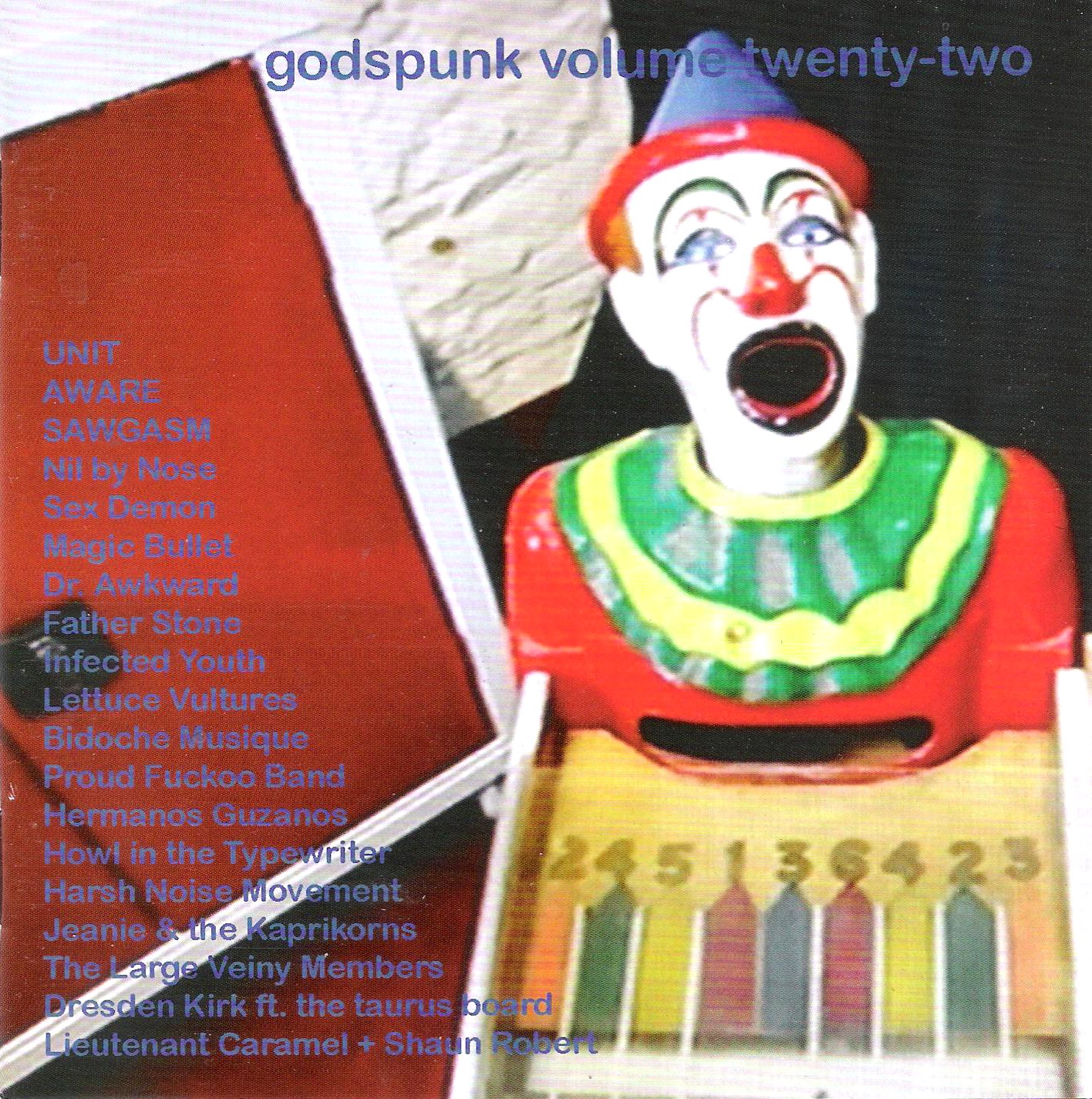
godspunk volume twenty-two (2021)
I should possibly open by declaring certain details which may suggest a lack of objectivity on my part. I've known Stan Batcow, the man behind both this compilation and the Pumf label which spawned it for a plurality of decades. He's appeared on things I've recorded, and I've appeared on stage with him back when he was blowing a jug for the Ceramic Hobs. I contributed to the first three volumes of godspunk, and have been a member of one of the bands who contribute to this collection. Anyway, Stan has been sending me the latest volume of this thing since way back whenever, usually with some disclaimer along the lines of I know you probably think this is a pile of shite, but it's free, so bollocks - you'll have it and like it, or words to that effect; and I always feel as though I should make the effort to review the thing, or at least spread the word in some way, but I never do.
It isn't that I think the godspunk compilations are a pile of shite, but I've often found them a bit of a mixed bag. There's been some great stuff on godspunk over the years - not least being the Las Vegas Mermaids and one of the Shend's rare solo outings - but there's usually a couple of tracks I'm not so keen on, and I always feel awkward about it. Actually there have been at least a couple I've actively hated.
The deal with godspunk is that the artist contributes to the cost of producing a fancy compact disc, essentially paying for time on the disc and a page in the accompanying booklet. So if you have sixty quid, or however much it costs, you can probably get yourself on one of these. Although this has meant the inclusion of an occasional splash of uninspiring or otherwise workmanlike pub rock over the years, that sort of thing has generally been in the minority, and the eclecticism of these compilations tend to reflect the mix of weirdos with whom Stan Batcow breaks virtual bread rather than who just happened to have sixty quid to spare. The godspunk discs therefore tend to present a bewildering selection of pop, punk, DIY, techno, house, country, noise, avant-garde, prog, metal, rockabilly, free jazz, and trad garage just for starters; which can be a bit overwhelming if you're not prepared for it, which is usually why I'm left speechless.
I tend to listen to this sort of thing on a Discman while I'm out on my bike, and I took a slightly different approach with this one because it's the first volume issued on two discs. Fearing sensory overload, I took the case with me so as to refer to the track list as I listened, and somehow it made a big difference, providing some kind of context to the anticipated barrage of random swerves. It still didn't mean I loved everything here, but it rendered the experience a little less like arbitrary twists of a radio dial and therefore a lot more interesting.
My favourite tracks came from the ever formidable Harsh Noise Movement - who directly big me up in the booklet for some reason; and Jeanie & the Kaprikorns who seem to be a country and western outfit, which may mean I've been in Texas too long, or not long enough depending on how you look at it. Also great are the Large Veiny Members, Taurus Board, and Nil by Nose - all godspunk regulars who can usually be relied upon to come up with something worth hearing; and Stan's own Howl in the Typewriter should probably have been mentioned in that sentence. There's also UNIT, of which I was a member back in the eighteenth century and concerning which my commentary might therefore constitute a conflict of interests, although I will say that it's probably the best stuff I've heard from UNIT in a long time, at least in so much as that a couple of their tracks feature none of the usual easy listening glockenspiel overload and are therefore almost listenable, if a little more clean cut than I like; having said which, I could have lived without the Apostles classic Anarchy, Peace & Freedom rewritten as a self-improvement anthem. Infected Youth banging on about H.P. Lovecraft didn't really do it for me either, but never mind - a couple of duds amongst what amounts to nearly fifty tracks isn't a bad average.
I suspect the mistake I've been making with these godspunk collections, aside from taking them along as I go out and about but leaving the track list at home, is listening to them as I might listen to, off the top of my head, Rising from the Red Sand or some compilation demonstrating a fairly specific focus; because godspunk is essentially a spigot. You turn the tap and weird shit gushes out in seemingly random sequence. The key to appreciation is therefore in riding the gusher, going with the flow, and expecting to be surprised - which you absolutely will be. With editorial policy being whoever happens to have sixty quid and something they want to share, one might be forgiven for certain assumptions regarding godspunk; but it's worth remembering that it's 2021 and the majority of talent free shitehawks will most likely be clogging up Bandcamp or similar download sites because they're free and easy, or at least easier than physical media has become. So rather than godspunk assembling an array of ageing pub rockers who just happen to have cheque books at the ready, it's probably closer in spirit to the tapes once issued by Music for Midgets and the like, by virtue of contributors having eschewed the path of least resistance, musically speaking; so check the fucker out, is what I'm saying here.
Pumf Records link up there on the left hand side of your screen.
Wednesday, 28 February 2018
The Mob - Let the Tribe Increase (1983)
I always dreaded the arrival of my mid-life crisis, but it seems to have worked out quite well, so well in fact that it's probably not so much a crisis as just me buying a load of records. I never learned to drive, so a bright red sports car would be useless; I always thought leather trousers looked fucking stupid; and I'm happily married with no interest in either conspicuously young women or showing them my Charlie Browns. My mid-life crisis has coincided with a period of unusual contentment on my part. I'm settled and comfortable, at long last, and so my attention has inevitably turned to getting hold of all those records I meant to buy at the time, but never did.
I taped I Hear You Laughing - the flip of their single on Crass Records - off John Peel all those years ago, decided they sounded worthy of investigation, and then never got around to it. At least a decade slipped by before I came across that live album with the Apostles on the other side in a junk shop in Lewisham, and a test pressing too - which always struck me as weird. Naturally I bought it, being something of an Apostles obsessive, but I have no memory of playing the thing beyond a vague impression of the Apostles set being a little ropy. Then last year I read some essay about the Mob in the excellent And All Around was Darkness and noticed that the band remained more or less a mystery to me. So I dug out the live thing, immediately saw the error of my ways, and tracked this down - a lovingly tooled and expanded vinyl reissue from Overground.
Anarchopunk bands associated, however loosely, with Crass have a certain reputation for black clothes and scowling, and apparently even Peel cracked some joke about the Mob's apparent lack of cheer after playing one of their records. Of course, the overtly political subject matter proposed by such bands was often that we're all being screwed and society is bloody awful, which seemingly left little scope for light-hearted chuckles. However, as with the received wisdom of how all those Crass bands sounded the same, it's not really true.
Possibly aside from the vaguely jazzy Roger, the Mob sound nothing like Crass. More than anything they remind me of New Model Army - a big heroic rock sound of a kind associated with young men whose generous locks doth flow photogenically in the north wind as they stand atop some rocky promontory gazing fearlessly into the future, but without the usual excess of production; and while the lyrics may indeed be relentlessly bleak tales of man, woman, and child crushed beneath the heel of an oppressive consumerist state, there's a real sense of joy to these songs, specifically the joy of the understanding that there will always be hope on some level, the adrenaline rush of resistance and engaging the enemy.
In fact, the more I listen to this record, the more it sounds like a celebration, a call to arms, something a long, long way from the promised threnody. I'd rhetorically ask where this album has been all my life but I already answered that one in the first paragraph. Let the Tribe Increase is magnificent, and definitely a better deal than fast cars and dolly birds.
Thursday, 28 January 2016
Bourbonese Qualk - 1983-1987 (2014)
It seems strange that I should only ever have knowingly heard one piece of music by Bourbonese Qualk prior to this - something on some compilation or other, a track I can barely remember beyond that it incorporated a loop of someone saying the name of the band. It seems strange because I knew of them well enough to have a couple of their more artistic flyers blu-tacked to my bedroom wall when I was a kid, Recloose Organisation advertising which had come in the mail with someone else's tape, and yet somehow I never got around to actually picking up an album to see what it sounded like. It also seems strange that around the time I was sticking their publicity material to my wall in an effort to impress on my parents that I was weird and yet immensely discerning, Bourbonese Qualk would have been living in the same Camberwell squat as a girl with whom I was eventually romantically entangled. She mentioned having once been acquainted with Steve Tanza of the band. She may even have powdered his nuts for all I know.
Additionally there is my friend and former bandmate Andy who helped run a venue called the Recession Club somewhere in Hackney back in the eighties, and who recalls putting Bourbonese Qualk on with some rancour, claiming they behaved like spoilt rock stars, or words to that effect, although it may have been self-important public school boys - one of those anyway.
Anyway, whilst there have been many occasions of my passing over a Bourbonese Qualk release in order to purchase the work of a recording artist with whom I am better acquainted, it's a different story in the San Antonio branch of CD Exchange where a Bourbonese Qualk disc cannot fail to stand out amongst the oeuvre of Brownsville Station, Michael Bolton, and every album Pat Benatar ever recorded.
I always imagined they would sound more like the Residents for some reason - probably the silly name - or else that they would sound formless and abstract by terms far beyond my powers of prediction, or at least not industrial, which thankfully they aren't. More surprising than anything is that they remind me fairly heavily of Rough Trade era Cabaret Voltaire with touches of 23 Skidoo or even Portion Control; which isn't to say that they lack originality so much as that this material quite clearly belonged to a particular era - distorted vocals, wailing reverb, and a rhythm through digital delay with the repeat time way down and the feedback up high. Had they signed to Factory Records, I don't think anyone would have been too surprised.
This may not seem like much of a recommendation but context is everything, not least when you consider what else was around during the eighties, not least Pat Benatar. Bourbonese Qualk may have trodden a vaguely familiar path but you can still hear them pushing it, trying to break out of the familiar, striving to bring new sounds to the fore, to communicate something; and to be fair, on the strength of this collection, they made a better job of it than Portion Control for the most part; and the more I listen to this one, the more I notice how greatly it differs from that to which it seemed initially quite similar.
As I've said before, better late than never, I guess.
Thursday, 10 September 2015
New Model Army - No Rest for the Wicked (1985)
New Model Army were never obvious candidates for membership of my record collection, but they sort of came to me through a process resembling osmosis. I spent at least a couple of weeks of 1985 in proximity to Chatham's small but daunting contingent of New Model Army fans, wearers of leather jackets and clogs who regularly undertook a hajj to Bradford, presumably to camp out in Slade the Leveller's garden or something. Ordinarily I might have been a bit creeped out by such over-investment in the oeuvre of just one band, but as I came to appreciate, New Model Army were actually a pretty good band, and if you're going to join a cult, than it may as well be one with a few decent tunes to its name - thus disqualifying anything involving Porridge. New Model Army appealed to me for the same reason that the Apostles appealed to me, specifically that with all the anarchy, peace and freedom then so popular amongst the yoots of a certain social stratum, it was kind of refreshing to hear songs about kicking Nazi heads in or throwing insurance salesmen from the top of tall buildings.
In terms of their following, New Model Army seemed to be what happened once goths got fed up of townies taking the piss and duly started punching faces, presumably having come back from summer holidays spent lifting concrete blocks on some farm somewhere - kids with an inherent distrust of authority who might be a bit sensitive in certain respects, but nevertheless enjoyed the occasional punch-up of a Saturday night after the pubs had closed.
Musically - at least at the time of this album - New Model Army were sort of Crass or maybe Conflict crossed with Big Country, or something in that general direction. It was a huge, pounding sound designed to reach all the way to the back of the stadium, an anthemic cry by which rugged men would face the sunset with their long hair flowing majestically in the north wind like anti-authoritarian lions. It was the point at which Led Zeppelin crossed over with Steeleye Span or summink. I suppose what I'm scrabbling at is New Model Army playing folk music, albeit a face-punching variant drenched in patchouli and preferring snakebite to anything one might serve in a pewter tankard. In other words it's populist, perhaps even addressing the accusation that I've heard made of Crass and others that the harsh form taken by the music greatly limits the range of its audience, which is a contradiction when that music is specifically concerned with communication. New Model Army's music on the other hand gushes in positively cinematic terms. It's powerful and simple with obvious mass appeal, and such obvious mass appeal that I got away with buying my dad this album for Christmas one year, telling him it was a bit like Big Country or Thin Lizzy.
Of course, it might be pointed out that the direct simplicity of most New Model Army songs, the way in which they tend to reduce everything to black and white, isn't significantly different to what the Daily Mail does - all furrowed brows and mobs formed on the promise of how we're not going to stand for it any more. It might also be pointed out - as I'm sure that bloke from Conflict probably noticed - that New Model Army unwittingly represent commodified revolution, a low calorie upsurge of ambiguously directed anger and emotion when compared with those of their contemporaries who managed to put out records without signing to EMI. Whilst both points may hold some water, I'd say it's probably a question of degree, and even a Crass album is probably commodified revolution if you've purchased it through Amazon, so there's possibly not much joy in getting too puritanical given that even commodified revolution is better than growing up with nothing stronger than Peters & Lee.
Thirty years later, No Rest for the Wicked still sounds fresh, not even particularly dated - which is surprising considering all the flangey bass effects. This is probably because they've always seemed like they mean it, and they achieve that rare synthesis of sounding both uplifting and fucking furious in the same breath; and it can't hurt that their message of not letting bastards grind you down is unfortunately timeless.