Wednesday, 27 July 2016

Bikini Kill - Reject All American (1996)


That whole riot grrrl thing more or less passed me by. Most of that which received coverage in the music papers seemed to be written by the fantastically irritating Everett True and I therefore ignored it on principle. I bought Huggy Bear's Taking the Rough with the Smooch 10" plus that split album they did with Bikini Kill and can't recall the first fucking thing about either of them aside from a vague memory of screeching aplenty and it all sounding a bit like a Billy Childish side project without the tunes or much of a reason to exist. I saw Huggy Bear live a few times, and don't remember much about either them or the Voodoo Queens - who I think were supporting - apart from what a wake-up call the brilliantly insightful Supermodel Superficial turned out to be. I had always imagined, for example, that in person Naomi Campbell was probably sort of like a cross between Marshall McLuhan and Noam Chomsky but with tits, so the Voodoo Queens certainly set me straight about that one, let me tell you.

Huggy Bear also recorded at Redchurch Studio, as frequented by the band I was in at the time. Fred the engineer hadn't been particularly impressed by them. 'It seemed to be just this young boy apologising for being male whilst some of the girls stood around taking the piss out of him,' he sighed, shaking his head and lamenting the death of the guitar solo. 'You know what I mean, man?'

I picked up some riot grrrl zine from Rough Trade. I can't even remember the name of the thing, but no-one I'd heard of was involved and it seemed to be self-absorbed incoherent shit from cover to cover - the print equivalent of some teenager stood on a chair shouting I'm expressing myself and you can't stop me for a couple of hours. It was so bad it actually made me slightly nostalgic for Smiling Faeces and its like. Smiling Faeces covered bands with names wherein the letter A was customarily circled so as to double up as a symbol of studded leather and home-brew based anarchy, and the editor asked probing questions like when did you form?, how many people are in the band?, and what do you think of the government?; but at least he was fucking trying.

Anyway, more recently I saw a fairly engaging documentary about Kathleen Hanna and was inspired to wonder if maybe I'd been missing something. The split album with Huggy Bear still didn't sound like anything too amazing, but I picked this one up cheap before the curiosity wore off, and okay - I do see the point, at last; I mean I've always seen the point of working outside the music industry, messing up the stereotypes and so on, but it's also nice when the music has a bit of a fucking tune to it. Unlike the seemingly cacophonous Huggies, this rocks and rants and screeches with just enough garage-based passion to remind me how much I love X-Ray Spex, and if someone had played me this disc without telling me who it was, instead claiming it to be some forgotten Sex Pistols support band, I'd probably believe them. Some of it even reminds me of the Who when they were good! The politics and the feminism were of obvious importance to Bikini Kill, but you can really tell they actually wanted you to have a good time listening to their music and at their shows; which I suppose is where the English version failed so hard, let's have a good time not really being something we ever did with much conviction. More importantly, Bikini Kill understood that the medium and message were not necessarily mutually exclusive, and that one shouldn't negate the other - Geri's girl power being something which probably could have been communicated by means other than tits bulging from a Union Jack push-up bra, for one example. The songs are short, sharp and catchy without quite ranting or succumbing to sloganeering, and yet there's no ambiguity about what we're dealing with, no sensitive testicular feelings spared for the sake of a sale or a play on MTV or whatever was around at the time.

I never liked the term riot grrrl on the grounds that no actual riots resulted, so far as I'm aware, and grrr is just letters that idiots write on facebook when they wish to communicate anger but have no intention of actually doing anything about whatever has pissed them off; so I'm just going to call this punk rock, because that's what it is, and because it's a shame that very little punk rock is ever quite this good. Time to have another go with that split album, I guess.

Thursday, 21 July 2016

Cabaret Voltaire - Code (1986)


I've just had a look for my Don't Argue 12", it being the last Cabaret Voltaire record I ever bought new as it turned up in the racks. I was hoping to compare notes because I recall it being fairly rubbish with soulful backing vocals in the spirit of Go West, Johnny Hates Jazz and all the other useless pop wankers of the day. It seemed like Cabaret Voltaire's equivalent of Bowie's Let's Dance 12", not much more than a slightly smelly appendix to an impressive but suddenly finite catalogue indicating that the game was up and there would be no need to bother with future releases. I was hoping to compare notes because the album version of the same track is pretty decent, being thankfully bereft of some woman wailing no, don't argue with me, you better watch your step, boy - woah yeah and all that. Anyway, I no longer have the 12", so I must have got rid of it due to it being shit. Never mind.

No don't argue with me, you better watch your step, boy - woah yeah was why I didn't buy Code. I picked a couple of later singles out of bargain bins, and if they weren't quite so bad as the aforementioned extended jacket with the sleeves rolled up to the elbows megamix of Don't Argue, neither did they do much to change my mind; and then the boys turned up on the telly in track suits adopting acid house mannerisms of such hilariously opportunistic thrust as to make Altern-8 look like Miles Davis. It was clearly all over.

Au contraire, some bloke on the internet explained to me in seemingly implausible defence of Code; so I bought one because it was cheap on Discogs, and both Bill Nelson and Adrian Sherwood are involved - which has to count for something - and curiosity got the better of me.

I was a relative latecomer to Cabaret Voltaire, discovering them mainly through spurious association with Throbbing Gristle - apparently it was usually the other way round for most people. They have become the eternal second name of the list for tedious wankers taking it upon themselves to bring us the story of industrial music - everything from Ministry to U2 and back again. Disregarding for the moment the fact of the term industrial music being a complete waste of time, I personally think the list has it the wrong way round. Throbbing Gristle were often wonderful, but once you've listened to them a few times the novelty wears off, the shock subsides, and it becomes clear that they only ever really did just the one thing. Cabaret Voltaire's back catalogue on the other hand continues to yield new aspects years after the moment has passed. You can listen to those things over and over and still find unfamiliar and unexpected elements. It sounds like a cliché, but I guess that's because they really were all about the music, man, or at least the sonic experimentation but let's call it music anyway. There's weird and startling, but not much in the way of shock effect, and no boggle-eyed interviews banging on about how the Third Reich were really, really interesting.

So here we are, and much to my embarrassment, Code turns out to be pretty damn great. It's clearly something that wouldn't have scared the living shit out of fans of Go West, and doubtless some Parlaphone marketing drone had his fingers crossed for that very reason, but it still sounds like Cabaret Voltaire. Adrian Sherwood's ruthless application of precision sampling and all those hard gated snares works well given that Tackhead records of the time probably weren't a million miles from mid-period Cabaret Voltaire, in spirit and approach if not actual sound. Still we have those elusive sequencers pinging away in the background in approximation of the treated guitar parts on earlier records, and it never quite adds up to a tune or even songs so much as a groove. There's always been a dance element to our music is almost always bullshit, but it applies here when you consider that the influence of dub, James Brown and even Parliament could be heard at least as far back as The Voice of America, certainly more so than anything of more obviously Caucasian thrust.

I had assumed Code to be the sell-out album, probably because I read as much somewhere or other, but it really isn't. The grooves are possibly harder than before, but they aren't doing anything they hadn't already been doing at least since Rough Trade. On the other hand, I had a listen to Groovy, Laidback and Nasty - the one which came after - on YouTube, and the cunt sounds like eight variations on Take That's Relight My Fire, so I think I'll leave it there for a while.

Wednesday, 13 July 2016

The Doors - Greatest Hits (1996)


The other day I picked up Dangerous, a CD of one of the late Bill Hicks' stand-up shows from a branch of Half-Price Books in San Marcos, because I like Bill Hicks and I think he's funny; or I thought I did. We listened to the disc on the journey home - the we here being myself and the wife rather than the royal we - or at least we listened to some of it. Most of the material was fairly familiar, having turned up elsewhere, and then he gets onto a rant about Debbie Gibson who apparently made some crap records back in the late eighties. Bill's objection seemed to be that Debbie Gibson should be regarded as essentially worthless because her music appealed to teenage girls and could hardly be compared to the work of the greats - Jimi Hendrix for example. Bill then went into some monologue about Debbie Gibson jamming with Hendrix, a pairing which would of course expose the futility of her existence, concluding with a description of Debbie Gibson lezzing it up with the similarly worthless Tiffany, focussing in particular on descriptions of presumed hairless vaginas; and suddenly I realised that I was never quite such a fan of Hicks as I once believed myself to be.

It's one aspect of rock I've always loathed with a fucking passion, that whole priapic shithead rock God of the sixties deal - arseholes you would ordinarily cross the road to avoid who by rights should be digging ditches for a living and voting UKIP, but having once held a tune whilst in proximity to a tape recorder for about five minutes, they've somehow come to be regarded as prophets of the age. I don't actually have anything against Jimi Hendrix, or any of them in particular, and I'd probably almost certainly rather listen to him than to Debbie Gibson, but it's the assumption which drives me batty, namely the assumption that the legendary status of certain persons goes beyond a few natty little tunes, that some poorly quantified quality of cool necessarily renders these people any more interesting or deserving of recognition than, off the top of my head, Mike Batt or Jonathan bloody King. The assumption forms the basis of why shagging a drunken twelve-year old is apparently sweet lurve woah yeah baby cruel talkin' woman rather than kiddy-fiddling if you're sufficiently famous with just the right quota of roguish genius, and providing it happened a while ago and that she was into it, man.

Not that any of this specifically applies to Jim Morrison, but it relates somewhat to why it's taken me this long to own a Doors album of any description. There was a bit of a revival around the time I was still at school, somehow thanks to Echo & the Bunnymen, and I had at least one friend who suddenly had all of the Doors records, wore beads, and took to describing things as groovy at least until the Sisters of Mercy came along. Morrison was a poet, they said, the voice of his generation, a troubled warrior of the soul and all that stuff which just sounds like horseshit to me; but, even I had to admit through the passing haze of my hatred for all things sixties, that the Doors had some cracking tunes; therefore fuckity fuckity fuck!

So I've been on the look out for a Doors hits collection for some time - admittedly not looking very hard - and I found this which ticks all of the boxes but for Crystal Ship, so close enough.

Just to wring out the last few drops of reservations - sorry, but Jim Morrison really wasn't a poet of any description, and his rambling bollocks on The Ghost Song really isn't so different to the stuff Sid James came out with on the Poetry Society episode of Hancock's Half Hour, and of course:

Do you love her madly?
Wanna be her daddy?

Ewww. No thanks; and it's probably convenient to the legend that he was so unfortunately snatched from our midst before he could fully succumb to the hamburger bloat presaged by LA Woman and the aforementioned Ghost Song, although interestingly enough, the post-Morrison incarnation of the Doors came up with some fairly decent material, so maybe it was him all along.

Anyway, regardless of the above, the Doors still sound fucking amazing when they were good, and Jimothy's voice was perfect for that bluesy combination of electric piano and fuzzy garage guitar; and so perfect as to pick up the shortfall of rhyming couplets like the above, because song lyrics really don't need to work as poetry. The legend is still off-putting, at least to me, mostly being mumbling crap amounting to they were the Stone Roses of their day, but stick this on and the sound coming out of your speaker short circuits all possible objections. If only half of those other supposed legends of that generation had ever delivered anything so strong as this lot...

Thursday, 7 July 2016

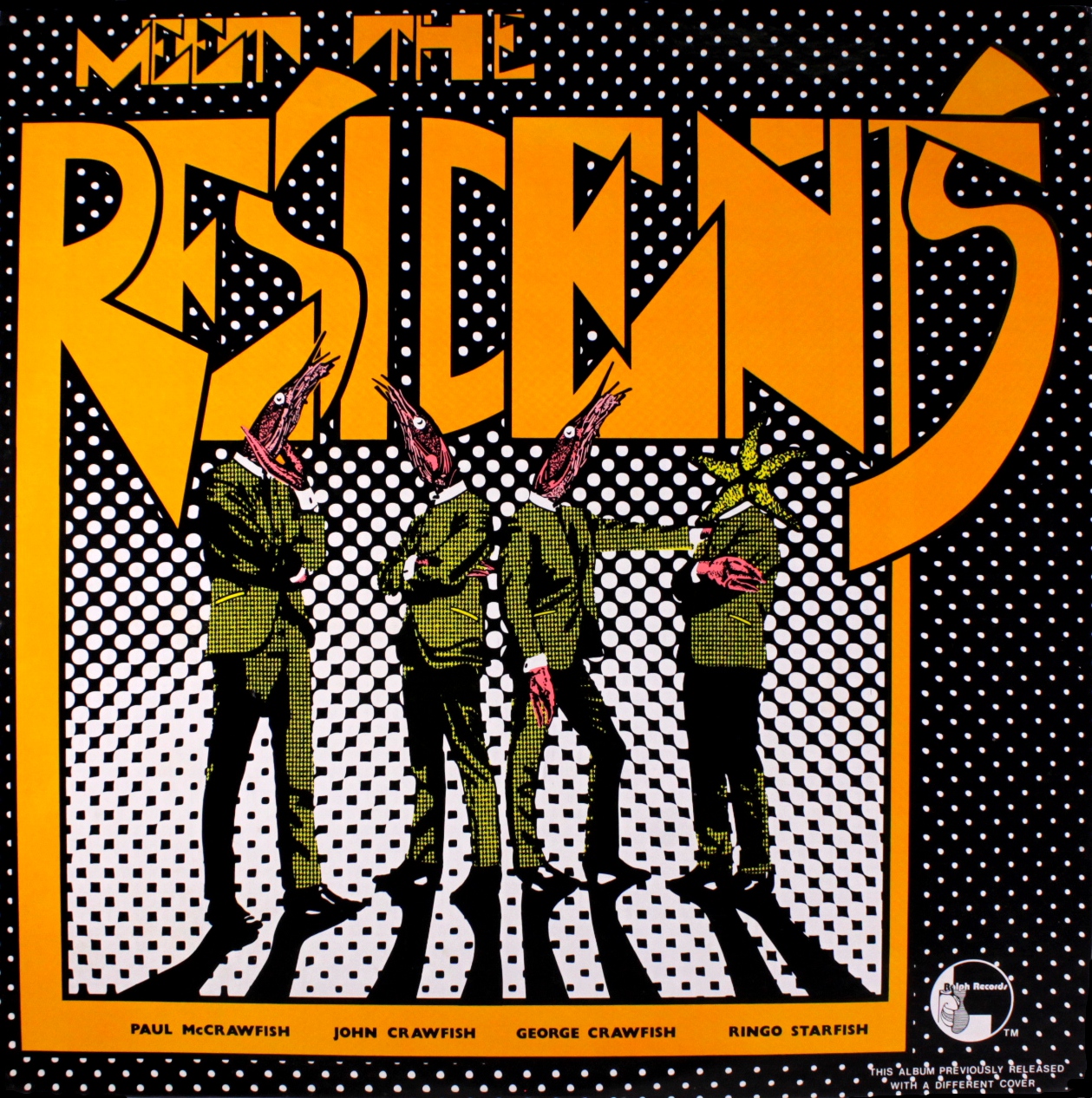
The Residents - Meet the Residents (1974)


For me, the Residents were yet another discovery made by means of raids on Graham's older brother's bedroom because he had all these weird, fascinating records by Cabaret Voltaire, Throbbing Gristle, Alternative TV and others, and notably the Duck Stab 7" EP. Graham's older brother wasn't at home much, and was reclusive on the occasions when he was - although at the time I mistook his crippling social anxiety for simply being too cool to hang out with schoolie wankers such as Graham and myself. For someone with whom I probably exchanged less than ten words in total, the enduring influence he has had on my listening habits seems incredible.

I probably encountered Duck Stab at just the right time. A year earlier I would have assumed it to be the work of some comedy act like the Barron Knights or the I Love Onions woman, and so it caught me just as I was beginning to appreciate that there could be more to music than four blokes with skinny ties and sunglasses playing muted chords. The Residents were fucking weird, and yet the music itself had purpose beyond providing a simple accompaniment to jokes cracked in a west-country accent. They were weird, but it seemed like there was more to them than just weird.

Amazingly, one of their records turned up in our local crappy record shop just as I was in the mood to make purchase of such a thing, namely the Nibbles compilation released by Virgin and more recently reissued as some overpriced Record Store Day artefact. Nibbles was a sampler covering the period prior to the release of Eskimo, with a few other goodies thrown in; and it was intriguing because none of us really knew anything about this band aside from that one album was called Not Available because Graham's older brother had a copy and we'd all taped it.

Then one day - specifically Tuesday the 30th of December, 1980 - I discovered Renton's Records in Leamington Spa, a town which was near but otherwise a little off the beaten track for me, and a shop which didn't actually look like a record shop. The murky windows were full of dusty trombones, violins, and other, more esoteric instruments; but inside was a single wooden rack of discs by Schoenberg, Terry Riley, Miles Davies, and all of the Residents albums, even Eskimo which had only been out since September. The covers were of thick card with smoothly rounded corners, and the vinyl felt more substantial than regular English records. Now I understood how those kids felt when they found that land in the back of their wardrobe.

I bought the whole lot over the next couple of months, then the Commercial Album when that came out, this time as an official UK release allowing me to feel as though I had been at least a little way ahead of the curve; then me and Graham went to see The Mole Show in Birmingham, and it was great but they were becoming something other than whatever I'd signed on for. Now using E-mu Emulators in apparent preference to cranky home-made devices held together with lengths of hairy string, they seemed increasingly prone to crowd-pleasing wacky cover versions and so I drifted away.

Meet the Residents remains their quintessential album for me. More than any of the others, it's the one which sounds like they're not even trying, and it sounds like that because that's just how the songs came out when they played them. There's something weirdly discordant about this music without any actual bum notes or obvious detuning going on; and an unsteady plinky-plonky quality despite no evidence of inept playing or timing; and everything's just fucking weird and in the wrong order and backwards without any obvious structural peculiarities of the kind one might expect from a Jethro Tull album. It's sometimes difficult to pinpoint just what it is that definitively makes the Residents sound so sharply at odds with more or less the entire history of popular music, possibly excepting a few underpublicised free jazz oddballs, so I suppose we might as well just settle for something along the lines of the Residents being how the Beatles would have sounded had they been drawn by Basil Wolverton. It's pop or folk music - not even anything special - from a world which probably isn't this one, and this is the key to its success: not specifically that it's weird, but that it doesn't even seem to realise that it's weird and feels as well-rounded and rooted and as confident of its own two-headed identity as anything by Otis Redding.

Later records seem to diverge from this wholesome core, at least to my ears, but here it was at its most powerful, its strongest vintage, back when it was doing much more than just weird. There's the terrible, hungover pathos of Skratz, the raucous alien lounge of Spotted Pinto Bean, and an entire host of other shades and colours which it just so happens we'd never seen before. The Residents have a whole string of great albums to their name, but they would have been just as great had they chucked it all in after this one.

Thursday, 30 June 2016

Nocturnal Emissions - Shake Those Chains, Rattle Those Cages (1985)


This seems an odd one even for a band who weren't above releasing albums packaged in a nappy - or diaper if you're reading this in the United States. Nocturnal Emissions had moved into moderately more tuneful territories since 1983's Viral Shedding - a rare beast which actually does sort of sound like house music before house music was a thing - or at least into the territory of their customary noise assault cannily rearranged so as to fool you into thinking it's pop music. Songs of Love and Revolution was some kind of punk hybrid with synthesisers and a refreshingly direct message - let's throw bricks at coppers rather than any of that I'm interestingly pretending to be Hitler so as to make a wry, playful comment on the nature of consumerism bollocks which was apparently still paying the bills at le Château de Porridge; and then this turned up in the shops and I bought it because it was Nocturnal Emissions.

More recently I finally got hold of Caroline K's Now Wait For Last Year, having been a bit skint when it first came out and not having realised there had been a reissue by Klanggalerie - which has inevitably sent me back to this one because some of the tracks are clearly related. I suppose this dates from roughly around the time that Caroline K was becoming less involved in Nocturnal Emissions, and Shake Those Chains, Rattle Those Cages feels like a collection of loose ends gathered together before moving onto the next thing, which by my calculations would have been the more organic, archaeological version of the Emissions and the setting up of Earthly Delights as a label.

All that being said, this is possibly my favourite Nocturnal Emissions record.

The live side was recorded at Bourbonese Qualk's Ambulance Station pretty much at the height of the British government being at war with its own people last time around, what with the miners' strike and everything; and it's unfortunately not that remarkable, an efficiently recorded snapshot of Nocturnal Emissions resumption of noisier activities whilst still wrestling with things that sound almost like songs.

The studio side however - just four tracks presumably constituting Caroline's final work with the band - represent some of the most emotionally powerful stuff I've heard from any band saddled with the unfortunate tag of industrial. Cleaner instrumental renderings of a couple of the tracks resurfaced on Now Wait For Last Year, but for my money, they were at their best here. The key to their power in this instance is that Nocturnal Emissions were writing songs using melody and sound with the same vaguely brutalist hand which informs the noise of Tissue of Lies and those earlier rackets; so the music sounds like a noise half-heard pounding away through reinforced concrete which has accidentally formed itself into something of near classical grandeur. The arrangement is at times so evocative it makes you want to cry, an invocation of the saddest thing in the world, a moment of such profound sorrow that only music could describe it - and of course it's very much a Nocturnal Emissions arrangement with everything in the wrong place, deliberately awkward, too loud or too quiet and just for the sake of seeing what the fuck will happen.

Nine o'clock... nine-thirty... nine minutes to ten...

Until what? Until they take you out to the back of the chemical sheds and stick a bullet in your head, by the sound of it; but it could just as well be about love. It has the same gravity.

I haven't been able to find a single review of this record online, which seems peculiar given the numerous eulogies recently written about Caroline's solo album - deservedly so, but this is still a more satisfying work for my money - one of the all-time greats in fact.

Thursday, 23 June 2016

Psychic TV - Beyond thee Infinite Beat (1990)


I've been somewhat down on the Porridge from time to time, although not in a sexual sense, obviously - that would be grotesque. This comes in part from having been a massive squeeing Throbbing Gristle devotee back when they were still an actual group, first time around. I couldn't get enough. I even had - and still have - those obscure bootleg tapes that were doing the rounds back then, the formative Death Factory studio stuff with Albrecht D and so on; so I was pretty serious about my dedication to the Gristle is what I'm saying. For me, they were not merely some name I encountered twenty years later whilst watching a documentary about Depeche fucking Mode, you smell me?

The appeal of Throbbing Gristle was the bizarre, alien sounds, not quite musical in the traditional sense and yet holding one's attention just the same; and the unsettling subject matter, usually tied in with the slightly sinister appeal of Porridge's monologue. He had a fascinating voice and - to break it down to something which would make sense in a pub - some of that was because we were listening just to see what he would come out with next. So when Throbbing Gristle split and Porridge took to believing his own hype, and it emerged that he'd actually wanted to be Lou Reed all along or at least just a fairly interesting pop star, I personally felt somewhat let down. It transpired that those once surreally absorbing monologues weren't so much inspired as simply because he'd never worked out how to shut it off, and those occasionally terrifying and always fascinating alien soundtracks had been largely dependent on who he'd been stood next to at the time. That's how it looked to me.

I bought the first two Psychic TV albums on the days they came out, and sold both of them within a year or so. Not even the customarily talented Alex Ferguson could save Psychic TV from their Jim Jones figurehead. There were a few things here and there which sounded sort of okay - Unclean and maybe some of Those Who Do Not - but the good stuff always seemed to be an exception to the rule.

Then in the late eighties, Porridge discovered acid house and somehow decided that it was sort of what he'd been doing along, and I laughed so much that I went out and bought one. Specifically I bought a couple on the grounds of the records having found their way into a bargain bin with surprising haste - first Jack the Tab, then the amusingly named Tekno Acid Beat, and finally this one. Jack the Tab is actually great - possibly thanks to the involvement of Richard Norris of the Grid - although it bears so little resemblance to house music that it might as well have been an Art of Noise album.

Tekno Acid Beat is the sound of people who've worked out how to programme a reasonable impersonation of the extended part of a Blow Monkeys 12" because acid house is just a drum machine going bum-bum-bum innit and you have some samples over the top like a bloke from off the telly saying far out a few times and stuff like that - piece of piss, mate; with Porridge and pals all giving themselves special kids on the street names like DJ Doktor Megatrip spelled with an industrial k, firmly stamping the whole clueless enterprise as someone's dad wearing a baseball cap turned backwards whilst declaring that everything is cool. Even the cover looked cheap and nasty, a ludicrous Psychic TV skull with a smiley acid face and all the class of a seventies Top of the Pops album. Somehow I wanted to like it. I really did; but every time I slapped the disc on, the music was the same - something which sounded as though it had been knocked off in about forty minutes, start to finish.

I gather this one involved a few of the same people, but somehow it seemed more promising, with a much better cover plus it was only a couple of quid and I was amused by Porridge having suddenly taken to claiming to have almost formed a band with Ian Curtis of Joy Division; and you know what - it ain't bad!

Of course this is a remix album, a remix album of ravemaster mixes; because when you go to one of those raves with the kids there's usually a ravemaster in charge, yeah?

Wicked.

Anyway, being a remix album it's mostly instrumental, so not much in the way of Porridge wailing the usual stuff about how he sees you and he thinks you're very nice; and given my theory - which I should make clear really is just a theory - that Porridge is musically only ever as interesting as who he's stood next to at the time - I guess this one is mostly a Fred Gianelli album, possibly with some bits of Dave Ball thrown in; and given that Fred Gianelli seems to know what he's doing and has actually heard house music, this does at least sound like what it's trying to be. The beats are a little obvious, predicated on the idea that all house music is bass-hi-hat-snare-hi-hat and repeat for ten minutes, but beyond that it's surprisingly good. The bass works as bass should, there's plenty of space, and very little of the bleeding obvious - that Italo house piano that turned up on fucking everything for a while, for one example. Additionally, much of this record has an oddly sombre tone, in contrast to much house music of the time, and by association enough original design to suggest some work and thought went into the composition, as opposed to a process amounting to that'll do because all it ever needed to be was a sound in the background of a Porridge monologue.

Of course, I could be wrong, and the man himself may have had a major hand in why this is a great record; although I've just listened to Towards thee Infinite Beat on YouTube - the album of which this is a remix - and it's mostly business as usual so I suspect possibly not.

Thursday, 16 June 2016

Athletico Spizz 80 - Do A Runner (1980)


Hearing Where's Captain Kirk? on the radio in the evenings  probably constituted my first awareness of it being possible for music to be wonderful without troubling the mainstream top forty or ending up introduced to pop picking telly viewers by a flared kiddy fiddler. Prior to the two or three spins it took for the song to sink in, I'm not sure I was even aware of there having been music other than stuff which had been on Top of the Pops at some point. Spizz, who by then had expanded to Athletico Spizz 80, featured in a double-page spread in my first ever issue of Sounds music paper, which I bought having become increasingly frustrated with the some of the hopeless shite receiving coverage in Smash Hits. The Sounds feature was illustrated by, if I remember correctly, team Spizz leaping athletically around a basketball court in what would eventually be recognised as skateboarding gear, and it made me think of Devo, another fairly recent discovery for me.

I've never quite stopped thinking of Devo where Spizz are concerned, which isn't to imply any sort of influence of one on the other, only that Spizz seemed to be the English expression of whatever had caused Devo. There seemed to be a shared sense of humour, a similar love of retrofuturism; and of course both bands have been regarded as faintly ludicrous novelty acts by those for whom anything with less testosterone than Ted Nugent may as well be Pinky & Perky. I have no strong recollection of how Do A Runner was greeted by the music press back then but suspect it may have been a general scratching of the head, as typified by an unusually Partridge-esque David Hepworth asking, 'It seems to me that the album sees Spizz going in a lot more serious direction than the singles previously had done. What do you think about that?' on the wireless back in August, 1980, to which Spizz himself responded:

Well, I don't know about that. Singles are supposed to be fun, pokey, short, snappy things and albums are just a whole wider range of what someone can do with a recorded piece, and that's what it is. It's basically a collection of all the songs which we didn't want to see disappear without reaching vinyl. We wanted to get all these out on record before they disappeared because we thought they were worth it and we didn't want to lose them, or to get tired or get old before they got to vinyl.

The notion of Spizz as a novelty act - as differentiated from simply a band or bands with a sense of humour - most likely stems from the success of Where's Captain Kirk?, doubtless fortified by later Trekkie-pleasing songs such as Spock's Missing and Five Year Mission; but it's a warped vision, as is obvious even from a quick ear cast in the general direction of the aforementioned fun, pokey, short, and snappy singles - not least the magnificent No Room which still makes most other records of that year sound shit, to be quite honest. Similarly, Do A Runner hardly constitutes frowning modernist essays from a former circus entertainer, what with the wilfully ludicrous Clocks Are Big and the general spirit of the thing, and - for fuck's sake - how could we ever have forgotten?:

Nuclear scientist producing plutonium,
Nasty little substance that we can't controlleum.

I suspect it's simply that we like a little more narrative consistency in our rock ascendencies, and Do A Runner was always at a serious tangent to a bloke jumping on stage with a guitar at some punk gig and making stuff up. It is equivalent, I suppose, to a new John Otway album sounding like Tangerine Dream; not that this does, but it's hard to miss the eight-minute pseudo-krautrock instrumental of Airships, or the weirdly angular Beefheartisms of Intimate, Rhythm Inside and others; except I suspect most of this material simply evolved out of the combination of these five people being in the band that year, and these being five people with no real interest in simply chugging out a few standards.

Do A Runner wasn't really quite like anything I'd heard back in 1980, and it still sounds reasonably unique thirty-five years later. I know Spizz did okay and is still remembered, but what with this one and Spiky Dream Flowers, I still don't quite get why he wasn't much, much bigger. I suppose someone will eventually dig this out and be able to listen to it without thinking of William Shatner, maybe even appreciate it for it's own very considerable merits. Maybe that person will turn out to have been me.