Showing posts with label U2. Show all posts

Wednesday, 6 July 2022

Coldplay - A Rush of Blood to the Head (2002)


I kept hearing this amazing song on the radio at work, but I could somehow never catch what it was or who it was by; and it took me about a year to work out that it was actually Coldplay. This came as something of a surprise because although admittedly it sort of sounded like Coldplay in slightly more pensive mood, it sounded better than Coldplay.

I never developed any particular loathing for Coldplay, but never saw any particular mystery in the idea that anyone might have done so. They sounded like an absurdly formulaic version of something which might have been more listenable under other circumstances, music for estate agents and automotive commercials, music for photogenic home insurance couples who'd listen to U2 but would rather not have to think about those kids in Africa with flies on their faces - corporate angst; and that's even before we get to Gwyneth's fanny candles.

Nevertheless, God Put a Smile Upon Your Face really wormed its way into my head - a song which sounds like the moment before a thunderstorm stretched out to three minutes, a depressive, doom-laden crescendo running away from itself. I would have bought the 7" but I'm not sure it existed, and CD singles always seemed like a bit of a waste of time, so here I am with an entire album - eleven fucking tracks. Strangely, tracks two to five were all singles, preserved here as a big chunk of hits at the beginning of the album and serving as a lesson in why it's taken me two decades to buy a cheap second-hand copy. It's not that In My Place, Clocks, or The Scientist are poor songs so much as that they're the same fucking song, and hearing it every thirteen minutes or so on whatever turdy indie station we kept it locked to at work used to get pretty fucking painful some weeks. Hearing them again after twenty years without the additional gurgling testimony of Jono Coleman or Christian O'Connell or some other dreadful fucking twat is less painful than I expected, and the more I listen, the more obvious it becomes that it's the context rather than the songs. This may also tally with the fact that God Put a Smile Upon Your Face didn't do anything like so well as the other three singles and never quite got to the point of outstaying its welcome at East Dulwich SDO.

Starting again at the beginning, allowing Coldplay a fair crack at the whip and ignoring both the terrible name and unfortunate association with Gwyneth's fanny candles, this isn't a bad album. In fact I find it unusually listenable. It isn't really that the good stuff amounts to the tracks which weren't singles, although there's a subtle difference in mood which probably accounts for In My Place, Clocks and The Scientist having been picked out; but the material you may not already have heard a million times somehow sounds more like a real band, and certainly less formulaic in pushing all those emo buttons with wistful verses building up to the same crescendo every time. Wikipedia gives their influences as bog standard hyper-mainstream shite but to me they sound like a post-psychedelic band, essentially Codeine with bigger production and Beatley chord changes; and this album is a lot more depressive than you might expect. I realise that this record should be shite but isn't probably doesn't fully qualify as praise, but I'm still slightly stunned to find myself listening to Coldplay and enjoying it. Had we never heard of them, had we not had to endure so many years of having them shoved down our throats over and over and over, it might be easier to listen past the bullshit and appreciate what they do.

Tuesday, 24 December 2019

Depeche Mode - Spirits in the Forest (2019)


'If there was a movie about them,' observed my friend Nick, 'they'd be running round the corner to escape the police in Basildon, and then be in a massive stadium with heroin addictions in the next frame.'

Surprisingly, there is a movie about them, and although Nick was off the mark where the plot is concerned, I nevertheless feel his comment expresses some deeper truth fairly well.

I recall Depeche Mode from way back, at least since they first started turning up in the pages of Sounds.


Ollie who worked in Discovery Records in Stratford referred to them as Depeche Toad, which was amusing; and Photographic on the Some Bizarre Album seemed like a fairly decent impersonation of Cabaret Voltaire, albeit without any of the funny noises which made Cabaret Voltaire interesting; and yet somehow there was a pervasive wholesome quality about them, something guileless, something a bit youth club with synths set up on the ping-pong table. This quality, whatever it was, lingered, rendering subsequent transgressions inherently comical, deeds effortfully undertaken as part of a futile effort to shake off the image, like kids with their first ciggies, lighting the wrong end and taking theatrical drags as though cameras might be running; and then there was the time they found those special sex clothes in that box at the back of dad's wardrobe, and then with the tatts and the arm candy...

I'm sure it was all real, but nevertheless, that's how it looked to me, and how it still looks despite everything. Even a few legitimately great songs - Two Minute Warning, Never Let Me Down Again, Enjoy the Silence, and probably a couple of others - can't quite shift the stench of pop, crisps, and jumpers knitted by your nan, which I propose even whilst holding that Dave Gahan is blessed with a genuinely powerful voice. I'm not even sure what it is - the ballsachingly appalling lyrics, Martin Gore's hair - which doubtless ensured that his dinner money never once saw the inside of the school canteen cash register, the plinky-plonky quality of certain songs, or something else, some emergent property resulting from a combination of indelibly wholesome factors.

Still, it was a free ticket for a film showing for one night only, so I wasn't going to say no, despite my reservations. I anticipated a documentary accounting for their transformation from Herman's Hermits into SPK and then ultimately into U2, but thankfully it was better than that. Spirits in the Forest has six Depeche Mode fans from across the globe tell their stories, interspersed with footage of a predictably massive concert in Berlin. It works because the fans, or at least these fans, are more interesting than the band, so they may as well be Lieutenant Pigeon obsessives for all the difference it makes; and I particularly enjoyed the story of DMK, a tribute act featuring a father and his two kids playing Depeche Mode covers on toy instruments. Actually, I think I liked them more than I liked the main feature.

The live footage, which punctuates the progress of our six fans as we follow them to the gig, fails to shed any light on the mystery of Depeche Mode, at least for me. What subtle qualities their less comical songs may have is lost once blasted out on a scale more suited to some Laibach parody, and Martin Gore standing around like a lemon with a guitar fails to make much difference to anything, and then we come to Dave Gahan, now a troubling hybrid of David Niven and John Waters whose face is too big for his head. His arms and legs are similarly too long for his body, which his weird Jagger impersonations only accentuate meaning that he now vaguely resembles one of those things from Ice Age. I don't understand why you would go to see this band, or why you would go to see them in a stadium the size of the Grand Canyon; but then I found it nevertheless watchable with a couple of decent tunes, despite it being Depeche Mode, so if that's your bag, I've no doubt that Spirits in the Forest must seem amazing.

Wednesday, 6 March 2019

Einstürzende Neubauten - Fuenf Auf Der Nach Oben Offenen Richterskala (1987)


I'm not sure why I never noticed it before, but I'm beginning to think we've been wrong about Einstürzende Neubauten all this time, or at least I have. Simon Morris of the Ceramic Hobs, an approximately close personal friend with whom I often enjoy a round of golf and himself no stranger to an ear-splitting racket, recently opined that he regarded them as either shit, grossly overrated, or a combination of the two, without quite being able to put his finger on why; which intrigued me because, although very much a fan, I could see that he had a point somewhere in there, or at least a perspective. I bought the earlier albums when they came out, and yet despite having just described myself as very much a fan, it's somehow taken me thirty-two years to bother with this one and I'm not sure why.

The first person I knew to listen to Einstürzende Neubauten besides myself was a vaguely gothy art college girl who also liked Tom Waits and ended up singing in a jazz band. She would occasionally drift off into a reverie about Blixa Bargeld's cheekbones, a fixation which I came to associate with her slightly disturbing monologues about the pleasure taken in not eating much and being able to feel her own rib cage. I suppose that's art school for you. Bargeld of course ended up in Nick Cave's band, presenting a similarly unfortunate association. I'm not saying Cave is lacking talent, but I've never seen whatever it is that others apparently see in his music, possibly excepting The Mercy Seat which is as wonderful as the rest is a droning racket. All of which seems to characterise Einstürzende Neubauten as the noise band most likely to turn up on the soundtrack of a Neil fucking Gaiman adaptation; but there's a reasonable chance I'm talking bollocks here.

The realisation that comes to me after a week of listening to - and enjoying, I hasten to add - Fuenf Auf Der Nach Oben Offenen Richterskala, and the thing which leads me to think we've been wrong about Einstürzende Neubauten all this time, is that they're actually more traditional than you might realise. Clearly they take delight in the subtleties of sounds derived from non-musical instruments, so we're still some distance from the Spencer Davis Group, but the noises and scrapes and clangs tend to form something vaguely Brechtian, very theatrical and - I suppose - amounting to medieval serfs forced to scrape a lament together with whatever metal objects happen to be at hand. I probably shouldn't be so surprised. Drilling holes in the ICA was nothing if not theatrical. They pull faces and make noises, but it's still entertainment.

Here they cover the Grateful Dead's Morning Dew, and it sounds oddly like Even Better Than the Real Thing by U2, but better, and preferable to the original to my ears, although probably not so good as Devo's rendering. It doesn't sound even remotely out of place either.

Having come to this realisation, I dug out Halber Mensch and gave it a spin, and sure enough, beyond the fact that we're hearing some dude thumping plastic water bottles with a wrench, at heart it could be a late seventies Bowie album. I don't suggest this to be a bad thing, by the way, and it doesn't mean I enjoy Einstürzende Neubauten any less, but it's been eye-opening and explains the Cave association. Further objections should probably be ignored on the grounds that the worst aspect of anything will always be its stupid fucking fans.

Wednesday, 6 December 2017

The Cravats - Dustbin of Sound (2017)


The return of the Cravats with a brand new album in 2017, a full quarter century after the last thing you could describe as such - which I suppose would have been Grimetime's Spirit of Disgust, sort of - probably qualifies as improbable, but perhaps not so improbable as the possibility of said brand new album being as good as it is; and it's very fucking good indeed.

The Cravats revivification looks a lot like some old spiky tops getting back together for one of those nostalgic festivals of which there suddenly seem to be so many, working out how to play the old hits, and in doing so noticing that the spark is still there; except that I'm guessing, and that this isn't quite the Cravats as were. The Shend is naturally still present and correct, or as correct as he's ever likely to be; and there's Svor Naan, with the rest having been reconstituted from remnants of the Astronauts, the Bevis Frond, the Joyce McKinney Experience and others. At first the thought of the Cravats without Robin Dalloway seems peculiar, and given the passage of time it all adds up to something which shouldn't work; and yet work it does.

The new lads are so well suited to the job at hand that it feels as though they've probably been there all along, at least in spirit, and thus Dustbin of Sound could never, ever be mistaken for anything other than a Cravats record; and if the absence of Dalloway is discernible in any shift of emphasis, then it's only because this is a different record, just as Motortown was different to The Bushes Scream, and The Bushes Scream was different to Toytown. This one's less jazzy than they've been, more of a growling motorbike beat, but still taking your ears places few other bands will tread through the magic of saxophone squiggles, angular guitar, and the Shend opening up your brain to reattach the wires to all the wrong nodules.

I'd pick out the best tracks, but they're all great with not a dud in earshot, although I suppose All U Bish Dumpers deserves some special commendation as the one which brings a tear to my eye.

The squirrel's role was to goad idiots
toward an unidentified trestle montage.
Chemical biscuit in Neptune franchise,
oh yes.
The mud and worm college closed for good in the 1440s
with the loss of hundreds of jam jars
Look at that rocket.

Yes, I know, and yet it feels somehow like a protest song sung with genuine feeling, the sort of thing U2 would have given their collective left bollock to have written, but which will forever be beyond them because they lack imagination. Like everything else on this record, it's - not even round, but a toffee-hammer-mammoth-bassoon shaped peg in a world of square holes. With the levelled playing field of homogenised juxtaposition as entertainment, with our ever-shrinking imaginations responding to Lady Gaga momentarily pulling a face as sooooooo random LMFAO, the Cravats remain very much a liberating cry of genuine unreason, something too weird to ever be sold back to us as a Happy Meal, and this may even be their finest album.

You should order this one from Overground Records. In fact you should probably order everything from the Overground catalogue because they're fab.

Thursday, 23 March 2017

Limp Bizkit - Chocolate Starfish and the Hot Dog Flavoured Water (2000)


Outside of this album, I find it really difficult to get past the off-putting impression of Limp Bizkit as having been a bunch of jocks - essentially what happens when members of the football team start writing poetry because someone told them it was a great way to up one's pussy-getting average. I also have Three Dollar Bill, Y'all$, their debut album, and I've tried to listen to the thing but it only seems to reinforce the aforementioned off-putting impression of dudes emptying cans of beer over their own heads whilst bellowing awesome! Maybe I need to give it a few more spins. I don't know.

So what's different here? Why does this one sound so good?

I wasn't going to buy the thing. I looked at their pictures in Melody Maker and understood them to be nu-metal - which sounded like a pile of wank to me, sort of like metal apologising for itself. I'd encountered Slipknot fans in Southend-on-Sea with their ludicrous black flares and eyeliner, the most harshly commodified rebellion I had ever seen - boutique punk rock at its most comical. I wasn't going to buy the thing, but I was curious at DMX apparently having turned up on one track, and there was some sort of poorly defined association with Eminem; and then my girlfriend's little sister gave me a freebie because she was working at the record company.

I've never quite taken the view of rap metal being inherently worthless - although most of it clearly is - or that white guys can't rap, but Chocolate Starfish and the Hot Dog Flavoured Water falters on both counts and the strength of the album is paradoxically that it works because of that. It isn't that Fred Durst couldn't rap, but he was never anything amazing in that department, and this whole thing would have sounded fucking ridiculous as a rap record with samples or whatever replacing the guitars. Durst's rhymes are mostly average and with that whiny upper register delivery he sounds like an eight-year old kid who just had his gameboy taken away from him, which itself accentuates the absurdity of all the homeboy schtick about Limp Bizkit being in da house and picking a fight with Trent Reznor for some innocuous comment or other; and it's because what is basically an American Walter the Softy crying into his ruined homework contrasts so starkly with the crushing riffs that we get a sound much greater than the sum of its parts. The beats are hard with a deep pensive bass and Wes Borland's guitar alternating between sharply gated walls of fuzz and something sounding surprisingly close to U2 without the bluster; all of which is pulled together as would be a hip-hop production yet without the end result sounding even like it's considered the possibility of calling itself rap. A few tweaks here and there and it could have turned out like one of those horrible whiny teenpunk bands, Green Day or Sum 41 or whatever, but the big difference is how that stuff parades its angst as a selling point, whilst all Durst's dirty laundry sounds so awkward and horribly personal - and with a bizarre mix of bragging and self-recrimination - it comes closer to the vengeful shit muttered under your breath when you're absolutely certain of no-one else being able to hear you. So despite everything, it's pretty intense stuff, like the volcanically impotent rage of the bullied kid who half feels that his muscular nemesis might even be right about some of that stuff. I should probably also point out that Durst sports a half-decent moody rock croon when he's actually singing.

That's why it works for me, and because the music is great.

Thursday, 21 July 2016

Cabaret Voltaire - Code (1986)


I've just had a look for my Don't Argue 12", it being the last Cabaret Voltaire record I ever bought new as it turned up in the racks. I was hoping to compare notes because I recall it being fairly rubbish with soulful backing vocals in the spirit of Go West, Johnny Hates Jazz and all the other useless pop wankers of the day. It seemed like Cabaret Voltaire's equivalent of Bowie's Let's Dance 12", not much more than a slightly smelly appendix to an impressive but suddenly finite catalogue indicating that the game was up and there would be no need to bother with future releases. I was hoping to compare notes because the album version of the same track is pretty decent, being thankfully bereft of some woman wailing no, don't argue with me, you better watch your step, boy - woah yeah and all that. Anyway, I no longer have the 12", so I must have got rid of it due to it being shit. Never mind.

No don't argue with me, you better watch your step, boy - woah yeah was why I didn't buy Code. I picked a couple of later singles out of bargain bins, and if they weren't quite so bad as the aforementioned extended jacket with the sleeves rolled up to the elbows megamix of Don't Argue, neither did they do much to change my mind; and then the boys turned up on the telly in track suits adopting acid house mannerisms of such hilariously opportunistic thrust as to make Altern-8 look like Miles Davis. It was clearly all over.

Au contraire, some bloke on the internet explained to me in seemingly implausible defence of Code; so I bought one because it was cheap on Discogs, and both Bill Nelson and Adrian Sherwood are involved - which has to count for something - and curiosity got the better of me.

I was a relative latecomer to Cabaret Voltaire, discovering them mainly through spurious association with Throbbing Gristle - apparently it was usually the other way round for most people. They have become the eternal second name of the list for tedious wankers taking it upon themselves to bring us the story of industrial music - everything from Ministry to U2 and back again. Disregarding for the moment the fact of the term industrial music being a complete waste of time, I personally think the list has it the wrong way round. Throbbing Gristle were often wonderful, but once you've listened to them a few times the novelty wears off, the shock subsides, and it becomes clear that they only ever really did just the one thing. Cabaret Voltaire's back catalogue on the other hand continues to yield new aspects years after the moment has passed. You can listen to those things over and over and still find unfamiliar and unexpected elements. It sounds like a cliché, but I guess that's because they really were all about the music, man, or at least the sonic experimentation but let's call it music anyway. There's weird and startling, but not much in the way of shock effect, and no boggle-eyed interviews banging on about how the Third Reich were really, really interesting.

So here we are, and much to my embarrassment, Code turns out to be pretty damn great. It's clearly something that wouldn't have scared the living shit out of fans of Go West, and doubtless some Parlaphone marketing drone had his fingers crossed for that very reason, but it still sounds like Cabaret Voltaire. Adrian Sherwood's ruthless application of precision sampling and all those hard gated snares works well given that Tackhead records of the time probably weren't a million miles from mid-period Cabaret Voltaire, in spirit and approach if not actual sound. Still we have those elusive sequencers pinging away in the background in approximation of the treated guitar parts on earlier records, and it never quite adds up to a tune or even songs so much as a groove. There's always been a dance element to our music is almost always bullshit, but it applies here when you consider that the influence of dub, James Brown and even Parliament could be heard at least as far back as The Voice of America, certainly more so than anything of more obviously Caucasian thrust.

I had assumed Code to be the sell-out album, probably because I read as much somewhere or other, but it really isn't. The grooves are possibly harder than before, but they aren't doing anything they hadn't already been doing at least since Rough Trade. On the other hand, I had a listen to Groovy, Laidback and Nasty - the one which came after - on YouTube, and the cunt sounds like eight variations on Take That's Relight My Fire, so I think I'll leave it there for a while.

Thursday, 10 March 2016

Go-Kart Mozart - Instant Wig Wam And Igloo Mixture (1999)


You know how you have first flushes of love tunes, those songs you will forever associate with a certain time when you began seeing a certain person, or possibly even having it off with them? If not, just bear with me. I kicked off with U2's Pride (in the Name of Love) which happened to occupy the pop parade just as I became involved with my first ever girlfriend. My second vaguely proper relationship arrived nearly a decade later and was scored to American Rock by Denim, which is possibly a bit of an odd choice, but is at least indicative of just how much I loved Denim at the time.

Naturally I had high expectations of Lawrence's next thing, and yet I've never quite got to grips with Go-Kart Mozart. I know it's supposed to be a sort of no frills Fine Fare yellow label version of Denim or something, and therefore has a bit of a pound shop stench as an inherent part of its musical genome, perhaps even as its mission statement; and having wasted at least twenty years of my life recording tinny novelty songs on crap equipment, Instant Wig Wam And Igloo Mixture should be a shoe-in for me.

I like the theory behind it, although the term theory suggests deliberation when it's probably mostly just gut instinct. Go-Kart Mozart is the Island of Misfit Toys of rock, the true face of our history. Stewart Maconie and other Spangle-gobbling revivalists have fooled us into accepting a version of our childhood in which Ziggy Stardust often read the six o'clock news, Faust were on Blue Peter every day, and On the Buses was funny.

I recently spent nearly a year writing a novel set in 1975, and part of my research constituted a month by month account of major news items, what was on the telly and what we were listening to. It was weird and slightly depressing, because whilst it's fun to remember the cool stuff, by sheer numbers it was mostly Barry Blue, Mike Batt, Jimmy Savile, and Kenny on Top of the Pops all in their matching jumpers with K on the front; and Go-Kart Mozart is assembled from this material, all the crap which we've written out of history, the details which will never, ever be remembered as cool, the stuff which just wasn't funny or charming enough for any of those I Heart the 70s shows. Musically this is the sort of gear which even fucking Stereolab wouldn't touch with yours, mate.

Accordingly, for all the dinky Bontempi tunes, Instant Wig Wam And Igloo Mixture feels oddly like one of those power electronics albums which pulls no punches in its mission to drive you to take the record from the turntable and fling it out of the window in disgust. It feels peculiarly extreme, particularly Drinkin' Um Bongo which combines African bloodbaths with cartoon juice box nostalgia to genuinely unsettling effect. It inhabits a world in which homosexuality is limp of wrist and will probably tell you to shut that door, and it writes an opera around Birmingham's Bull Ring shopping centre without so much as a smirk. It would make more sense if it was all done for chuckles, but it feels weirdly in earnest, which is itself funny, I suppose. I might like it more had it been recorded as a Denim album, although I suspect that may be missing the point, whatever it was.

Forget all those post-industrial types churning out album after album of self-conscious Dadaism, this is one of the weirdest things I've ever heard, and I still can't tell if I even like it or not.

Thursday, 31 December 2015

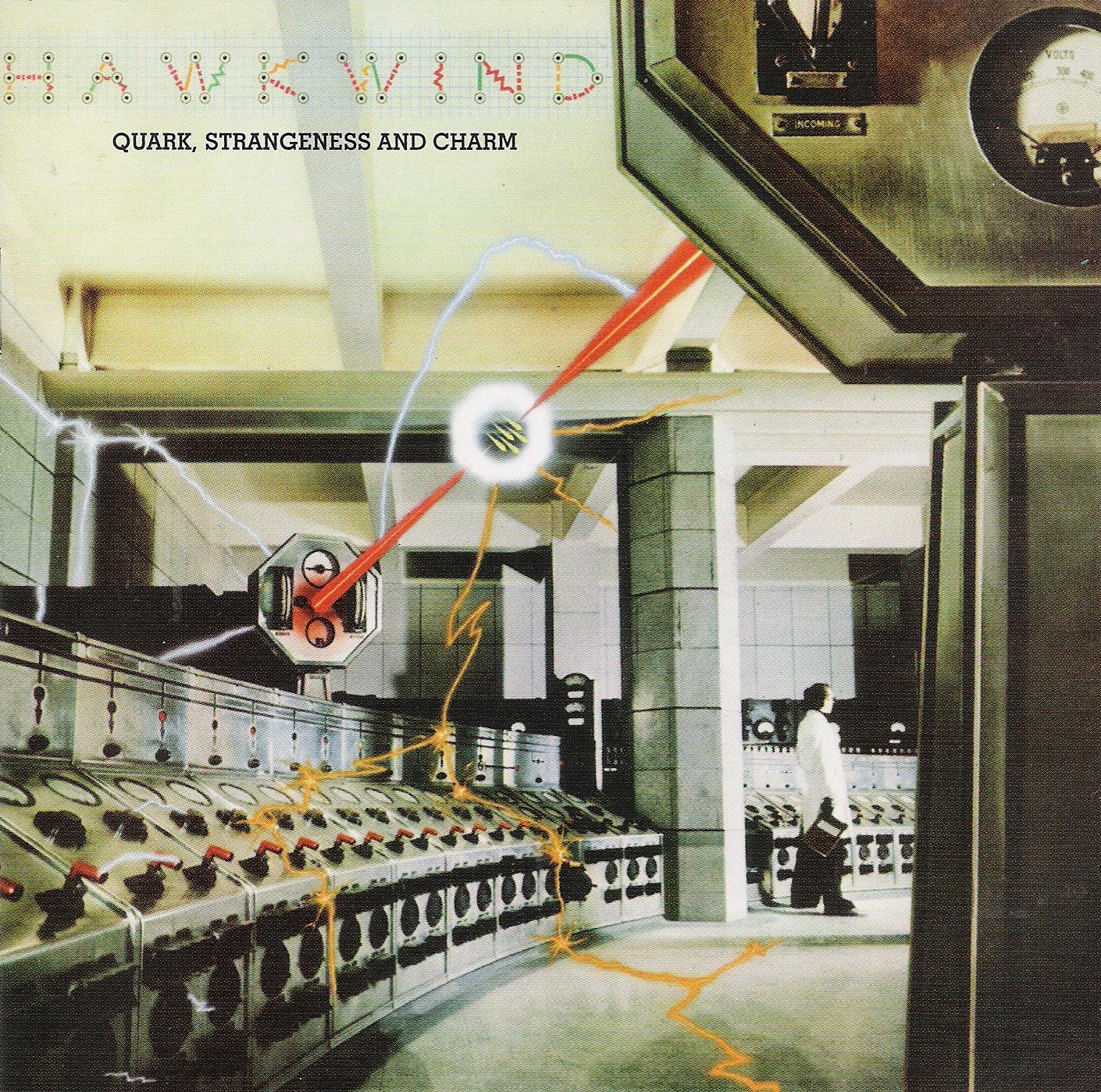
Hawkwind - Quark, Strangeness and Charm (1977)


I heard this very album played in the fifth form common room at school one lunch break thirty or so years ago, which is odd because I have no other memory of there having been a fifth form common room at my school. Similarly mysterious was the identity of the band. I assumed it was probably the Stranglers, although it wasn't a song I recognised and Hugh Cornwell's voice didn't sound quite right even though it was almost certainly him. I was surprised when I saw the cover, knowing Hawkwind to be a bunch of hippies probably sounding a bit like either Pink Floyd or Gong or one of that lot.

I'm kicking myself now of course. I'm not sure why it's taken me so long to get around to this one, although I suppose everything has its time. I probably should have taken the hint back in 2000 when Nigel Ayers of Nocturnal Emissions wrote the following in issue seven of The Sound Projector:

If you look at the whole of that so-called industrial scene from Cabaret Voltaire to Marilyn Manson, the band with the most far reaching influence wouldn't be Throbbing Gristle, but Hawkwind! This is something that they rarely mention in the press, as Hawkwind have this reputation as a British hippie band who do science-fiction and theatrics and therefore must be naff. Whereas if they were a German hippie band... Zoviet France have told me they were very keen on Hawkwind; SPK were well into Hawkwind back in Australia; and what are Graeme Revell and Brian Williams doing nowadays? Making soundtracks for science-fiction films - I rest my case! I think it's about time Hawkwind were reassessed. I have long been tired of those outfits who cite influences no-one has heard of, or can stand listening to. Back in the early seventies, Hawkwind were the first band I was aware of to popularise the idea of sonic attack, infra and ultra sound as a weapon. Listen to Sonic Attack on Space Ritual. That of course has long since been taken up by that whole noise scene, but Hawkwind were rarely acknowledged. If you look at the information war thing, you'll notice that Hawkwind had the post-modern writers, Michael Moorcock and Bob Calvert working with them. Though Moorcock is best known for his very popular science-fiction and fantasy genre work, it's more accurate to call him a postmodernist or at least a modernist. Moorcock pointed many in the direction of William Burroughs and J.G. Ballard and - stone me, he even wrote for Re/Search. When Hawkwind's In Search of Space came out in the early seventies, it came with a booklet of very similar material to what the London Psychogeographical Society, the Association of Autonomous Astronauts, Iain Sinclair, and Tom Vague have been doing more recently. Whenever I used to see Psychic TV, I thought Hawkwind. Whenever I saw Throbbing Gristle I thought Hawkwind without the lights and without the tunes. That combat clothing thing - Hawkwind! Which brings me to the point that I would definitely question the history of punk rock and weirdy music that overlaps it that media hacks have tended to spout. I remember that, apart from media darlings the Sex Pistols, the DIY punk scene in early '70s Britain seemed to be much inspired by the efforts of Hawkwind, the Edgar Broughton Band, the Pink Fairies and even Gong; and the context of the free festivals. Free festival, a self-organising proletarian cultural gathering often involving a bit of a knees up and maybe a punch up with the coppers, see also rave. Brian Eno, for example used to hang out with the Pink Fairies. The whole set-up and costuming of Roxy Music was a direct crib off Hawkwind; AMM - my arse! Eno's a popularist, otherwise why's he working with U2? In 1972 Hawkwind followed up Silver Machine - a million selling hit about a time travel machine built by the pataphysicist Alfred Jarry - with the single Urban Guerilla. It was pulled by the record company because of fears about an IRA bombing campaign in London at the time. They later re-recorded it with Johnny Rotten. Joe Strummer's 101ers and the Stranglers used to play on the same bill as Hawkwind in the free festival days, pre-1976. In interviews at the time, Strummer cited Hawkwind as an influence on the Clash's first album. Pete Shelley of The Buzzcocks admitted he spent a lot of his youth listening to Space Ritual and derived a lot of his musical direction from it; and of course Lemmy of Motorhead used to play bass in Hawkwind. Anyway, I went to see Sun Ra and his Arkestra once and I got bored after twenty minutes of that jazz shite and went home. I've seen Hawkwind loads of times and they rock!

Listening to this now, it's clear that the above is not only on point, but arguably just the tip of the iceberg, even beyond that unearthly electric chug which worked so well for Throbbing Gristle. The fact of post-Britpop Blur sounding a hell of a lot like this album, particularly The Days of the Underground, is probably only great minds thinking alike albeit a couple of decades after the fact; but this is just one of many parallels which seem to difficult to avoid. Case in point being professional industrial music arseholes claiming to have invented acid house or rave, when the established knowledge of who actually innovated such genres isn't negated by their being black guys who never went to art school; but it has to be said that the rave dynamic of extended mesmeric grooves built on riffs of weirdly crunchy sound - guitar in this case - somehow replicating the effect of coming up on a couple of disco biscuits, is very much evident on Quark, Strangeness and Charm. It's a very trippy album - which isn't a word I often use - and euphoric without the usual attendant drippiness of having to put flowers in your hair as you head off in the general direction of San Francisco. Hawkwind were rave before rave, occurring as their own near-autonomous culture in a way which sort of prefigures Crass, amongst others. Yet culturally they have a fiercely urban quality which references mainstream society, as opposed to everything being based on the world as filtered through the spout of a pot of mushroom tea. The lyrics resemble science-fiction, but then science-fiction is as good a metaphor as any for the problems of urban society, and certainly no worse than anything associating lurve with the light of silvery moons.

As with many compact disc reissues, this one is a double disc stuffed with demos, live versions, and so on. Ordinarily this sort of thing annoys the hell out of me. I want the album as it was, a discrete unit of culture with the same beginning, middle, and end, and exclusively comprising the stuff which was considered good enough to release at the time. The worst example of this sort of tendency might be the reissue of Suede's Head Music on three discs including previously unreleased material so dull that I'm surprised even the band would want to hear it ever again - rare out-takes and demos for an album which was actually kind of shit in the first place. Anyway, Quark, Strangeness and Charm turns out to be the opposite of that unfortunate bloating, which is probably testimony to the general quality of Hawkwind as an institution - extras which actually add to the experience. This is a sublime album and I'm definitely going to need more of this stuff.

Thursday, 17 September 2015

NWA - Straight Outta Compton (1988)


Still one of the greatest rap albums of all time, maybe the greatest, and still annoying the living shit out of people three decades later. Since the NWA movie came out a few weeks back I've experienced a huge and repetitive upsurge in the sort of complete bollocks people always come out with in proximity to this record and those who made it. Amongst the less contentious observations has been the traditional suggestion that It Takes A Nation of Millions knocks and will forever in perpetuity knock Compton into a cocked hat, alongside every other rap album which the person delivering the statement hasn't heard, which is usually almost all of them. Public Enemy were great, for sure, but this sort of thing always sounds to me like well, I'd rather support the work of responsible black people who know how to behave in polite company, in other words, I want to hear what you have to say, beleaguered minority voice, but within reason, and nothing I wouldn't be able to repeat in church.

It's my own fault for replacing all of my former social interactions with facebook. Mere days after the film came out, someone had politely befouled my page with an article about all the women Dr. Dre has beaten up over the years. I'm not sure if he expected me to apologise or something, but I'm disinclined to even discuss rap or its failings with someone who only gives a shit when there are censorious fingers to be pointed. The article was further embellished with the following response from another facebook person, one I've been ignoring since they shared one of those Muslims who don't like the flag should fuck off back to Russia type opinion pieces masquerading as a news article.

I have always wondered why so people enjoyed their music, and why now so many people want to go see their movie. There are a lot of people in the music industry that I just don't understand how so many people go crazy over. Why does society think it's okay to be hateful to some people, and make huge celebrities out of such hatred spewing forth from their "art"? There is so much more to be asked, but it has given me such a headache. It is not okay to be hateful and hurtful, and yet there society goes making hateful people rich and huge celebrities.

I know: person who doesn't like rap fails to like rap, which isn't what I find so aggravating so much as the notion that an opinion formed in general ignorance of a subject is now so often held to be as valid as actually knowing shit. I'm not a huge fan of that dancehall artist who used to advocate shooting homosexuals, but then I can't even remember who he is or what the record was, and I know fuck all about dancehall so my opinion, beyond a few basics, probably doesn't count for a whole lot.

Probably Dr. Dre is indeed a horrible cunt. The music industry is hardly lacking in horrible cunts, most of whom seem to get a free pass, and this specific focus on Dr. Dre as a horrible cunt seems significantly informed by how strongly we disapprove of his records, none of which - it might be pointed out - waste much time in trying to promote the image of Dr. Dre as a more caring amalgam of Bono, Val Doonican, and Deputy Dawg. I personally feel the relationship of artist as horrible cunt to his or her work is most eloquently expressed in this instance when Ice Cube asks do I look like a motherfucking role model? on Gangsta Gangsta, the answer to which is, most realistically, no he doesn't; and I think he would be surprised and disappointed with you if you said yes.

I'm not sure it's possible to make it any clearer than that. Straight Outta Compton was never meant to constitute advice, and if it upsets you, that's probably because it's supposed to upset you. Whilst this doesn't make Dr. Dre any less of a horrible cunt, neither does it necessarily invalidate his art or what any of them were trying to do with it, any more than Alice in Wonderland is a bad book because of the author's poorly quantified regard of little girls.

Musically it's sharp as fuck, one of those rare discs which makes everything else you listen to that month sound shite, at least while you're playing it. The rhymes are tight, brutal, absolutely on point, and often very funny because the album is a bunch of kids talking shit to their mates on a street corner rather than an earnest political address unto all the nations of the world; and if you don't think bunches of kids should be allowed to talk shit to each other on street corners, or that it's okay providing they first check with a responsible adult to make sure there's nothing that would seem out of place on the Disney channel, then fucking screw you because you're the reason people still need to make albums like this one.

The bottom line here is, I would say, that if you've ever been in the position of there being another person or group of people having so much power over you that you really and literally want to break their arm, leg, head, skull, or whatever it takes for you to shift that weight, then you will understand this album and why it was made and why there are sexual swearwords. If you've never been in such a diminished position then be happy because you're pretty lucky. Regarding those sections of human society still getting the shitty end of the stick in the twenty-first century, either you want them to have a voice, to maybe have some sort of say so as to be able to elevate themselves by some means, or you want them to shut up and keep making your trainers or serving your burgers; and if you want them to have a voice, you don't get to pick and choose what they say.

...then again, what the fuck do I know? I probably only listen to this because I think it's cool.

Thursday, 30 April 2015

UFK - Rage Against Florence + the Machine (2015)


UFK - or Unlucky Fried Kitten to give it, him, or them his or their full title - is Andy Fraser who I met way back in the eighties when he was singer, and I suspect main songwriter, for a group called the Martini Slutz. I only saw them a couple of times, but they were impressive. They felt like a proper punk band, something that had slipped through the cracks from that first wave when no-one could possibly confuse one group with another, just before it got all spikey and leather clad and just a little bit samey. The Martini Slutz were exciting live, and exciting in the same way I always imagined the Sex Pistols must have been - a certain sense of witnessing something special that probably wouldn't be repeated, and which significantly wasn't lacking a sense of humour.

Thanks to the wonder of the internet, I learn much to my pleasure that Andy is still at it all these years later, and against all odds, his powers seem undiminished. I'd heard a couple of tapes he knocked out under the names Death in Venice and then Basement Mania way back whenever, and had come to recognise Martini Slutz as having been just one episode in the life of a man who would probably explode if someone ever kept him from producing music; and its a testament to his dedication that he's kept on apparently regardless of the volume of whatever audience may or may not be out there - not because he has no interest in this stuff being heard, but because - to probably sound a bit of a twat - he's an artist in the truest sense of the word. He cares about what he does, and the rest is mostly just window dressing.

Rage Against Florence + the Machine is the second album under the UFK banner, and it should be noted that it is an album - a proper disc in a jewel case with a barcode and a fancy sleeve - not a feckin' download or a CDR with a phone number scribbled on the blank label side. This is nice because it suggests confidence in the material, and it turns out that said confidence is entirely justified.

I suppose if I have any criticism - just to get it out of the way - the songs mostly sound as though they've been recorded on some sort of digital set up, and initially all seem to have a similar tone and pace as a result; but fuck it - it's not like Rage Against Florence + the Machine hasn't already got more soul than most of the mainstream pop shite people post up on facebook every day, so it is what it is. Repeat plays accustom the ear to all the subtle differences here - all excepting the peculiarly abrupt cutting from one track to the next - but the words draw you in almost immediately, then pull you back for more once the forty-four minutes are up. There's a touch of Ian Dury to the song writing, or at least some of that same uncanny knack for jamming the most ridiculous elements together in a single sentence and making them work like poetry.

A mushroom, very soft and gentle,
Grows through concrete - that's just mental!

UFK songs often seem to focus on details so inconsequential as to seem almost comical, but always with affection, and often resembling a thought process much like the stuff which randomly dribbles through your head while you're stuck in a café staring out at the rain. Sometimes it's as small and simple as the above mushroom; other lines usher in matters of greater consequence, folks dying or car accidents; and whilst it may be a cliché to suggest that it's all part of life's rich tapestry, it's one of those clichés which happen to be true, which seems to be the point of UFK. Bizarre characters inhabit almost magically realist situations in UFK songs with more warmth and conviction than almost anyone since maybe Ray Davies, and so Rage Against Florence + the Machine sounds kind of unique in certain respects, particularly tone and focus, although I suppose that might say more about my general listening habits than this collection in particular. To summarise with the usual pointless scrabbling about for comparisons, try somewhere between a cuddlier Sleaford Mods and Frank Sidebottom - referring here to Chris Sievey in a papier-mâché head rather than the crappy hipster film inspired by the same; or Wreckless Eric crossed with Go-Kart Mozart, but much better; or if anyone remembers Space - that nineties bunch who brought us the fucking terrible Female of the Species amongst other similarly turdlike efforts - UFK is probably roughly what they thought they sounded like, but really didn't; or it's Swans covers of Splodgenessabounds if you want. I don't fucking know. Just trust me that it's great and buy the thing.

Buy the thing sharpish too, if you're going to. UFK have recently been receiving testy cease-and-desist style communiques from Island Records suggesting sales of Florence + the Machine entertainment products may be placed in jeopardy by the title of this album. It appears that there may be reason to suspect this mostly comes from one specific record company drone needing to make himself appear busy so as to justify his job by issuing overbearing decrees to bands no-one has heard of, possibly someone still stinging from Mr. Fraser having kicked up a fuss about the recent violation of his iPod with a free U2 album. Personally I can't help wonder if it's simple jealousy because next to this, Florence sounds like some self-involved drama student hooting away in an in-house Waitrose corporate training video.

Tuesday, 23 December 2014

Virgin Prunes - A New Form of Beauty (1982)


My first encounter with the music of the Virgin Prunes was at my friend Graham's house. We'd already discovered Throbbing Gristle, Alternative TV, the Residents, Faust, Wreckless Eric and Cabaret Voltaire through raids made on his older brother's frankly astonishing record collection, and this time it was A New Form of Beauty 3, the 12" component of an album released as a series of singles and a cassette. I didn't really know much about the Prunes, but the cover was great, and Beast (Seven Bastard Suck) sounded impressively terrifying. Unfortunately my funds - a combination of pocket money and what I collected from a paper round - didn't really extend to adding yet another band to the coterie of those whose records I would purchase immediately upon release and without question, so I somehow managed to miss out on this lot. I have since seen it opined on some blog that the Virgin Prunes could be roughly considered the most criminally underrated band of all time, and that this is in part due to their music having been out of print for much of the last three decades, which is probably a contributing factor to how long it's taken me to get there.

For those who weren't aware, the Virgin Prunes grew up in the same teenage gang as U2, feature the Edge's brother on guitar, and bestowed upon Bongo his nickname. Listening to their music and considering their enduring obscurity, it's difficult to avoid seeing them as either the repellent
Dorian Gray portrait in Bongo's attic, or at least a sort of dark karmic underside to U2's rosy cheeked optimism. Where U2 once stood atop a picturesque crag of God's good Earth with their youthful locks flowing cinematically in the breeze of passion, the Virgin Prunes writhed about in poo, smudged their make-up, and screamed and wailed as the more conservative members of the congregation asked one another is it a boy or a girl?

Gothic probably doesn't really cover it. Not only do they predate the term as a popular signifier of frowny faced bands with tastefully back-combed hair, but they made most of that bunch look like Buck's fucking Fizz. Drums bang, guitars scream and screech, and it all sounds very much like a performance, something closer in spirit to a story than a song in the traditional sense. For a while I was thinking Brecht or maybe Hogarth - something consumptive you can almost smell - but the more I familiarise myself with this music, it begins to sound positively iron age - primitive and weird beyond reason, Old Testament even, the kind of music with which one might praise a golden calf. There aren't really tunes so much as, I suppose, grooves, compelling and slightly fetid, and delivered with the force of sermons promising that you are all going to burn in hell!

I have a hunch that this may actually be how Porridge always imagined Psychic TV would sound, except of course they never did through being hamstrung by the presence of the selfsame oat-based William Burroughs' autograph hunter. This is the violent pre-Christian noise all those awful Crowleyite bands promised but never delivered because at heart, they really just wanted to sell their droning records to each other and get to hang out with the famous Porridge. This was the real thing, definitely underrated, and as the name promises, very beautiful in its own way. This disturbing, caustic racket really was a new form of beauty.

Thursday, 9 October 2014

U2 - Zooropa (1993)


Where did the time go? With each passing year, Bongo of U2 becomes ever further removed from that soulful wide-eyed Muppet Baby version of Joy Division which sounded so fresh and so utterly devoid of artifice in 1980, and ever closer to that which John Doran of The Quietus amusingly described as Smaug the Dragon with a mullet and two grand wrap around shades sitting on a giant mountain of gold, dressed like Che Guevara, talking about us and making peace signs any time someone gets out a camera.

More surprising for me has been realisation of the fact that they were never really so amazing as everyone thought they were. A Day Without Me and I Will Follow sounded like the greatest songs ever recorded that time I first heard them on the radio, but for some reason I never bothered to buy the album. The somewhat overwrought but still reasonably convincing Pride (in the Name of Love) was an - ahem - our tune in the Simon Bates tradition for myself and my first ever girlfriend, but then we were both pretty young and our other our tune was Smalltown Boy by Bronski Beat, so Lord knows what was going on there.

More recently I found that the song which Bongo's humble Oirish farmhands recorded for some Batman film had become lodged in my head, whatever the hell it was called; so screw it, I thought, and promptly Amazoned me a greatest hits disc. Unfortunately it turned out that U2 have had so many greatest hits as to require two volumes of the same, and I was sent the wrong one. No problem I decided, recalling the passion with which I once loved the three listed above, but listening to the fucker was another story. A Day Without Me, I Will Follow and Pride still sounded okay, but I'd forgotten about the rest, all those exhausting anthems, lonesome prairie-scale epics dedicated to being just a straightforward kind of fellah who, much like the Murphy's, isn't bitter, striving for the grandeur of a Thomas Cole landscape but coming closer in spirit to one of those hokey old west paintings full of noble savages and homespun horseback heroes. Never has anything with such celestial aspirations sounded quite so lard-arsed and stodgy, so lacking in basic nutrients as the never ending and pretty much interchangeable wailing ballads which comprise most of U2's back catalogue. By the time they recorded Rattle and Hum, it had begun to seem like even U2 were sick of it, at least revealing themselves to be a competent rock band once someone had taken away their fucking chorus pedal and told them to stop being such wankers.

I have most of Zooropa nailed into the back of my skull because my girlfriend of the time - not to be confused with the earlier one with whom I shared Pride as an our tune - had the album and played it to death. I didn't mind as it sounded good to me, and in fact it sounded so good that we went to see them live at some massive park in Leeds, a concert which I recall as immensely enjoyable despite costing over a hundred pounds a ticket once we accounted for missed coaches and resulting taxi fares. Weirdly, listening to it now, Zooropa still sounds good. The U2 of Zooropa and Achtung Baby - its predecessor - had apparently tired of being the aural equivalent of a plate of school mashed-potato ten miles in circumference and had asked Brian Eno to help them to be less crap - and I believe those were their actual words. I can't be bothered to verify whether or not this is true, but I seem to recall that as the recording for Achtung Baby began, Eno pointed out that the songs were rubbish and made the boys go away and then come back again after they had written some better ones.

Whether or not they did, Zooropa - and this works just as well for Achtung Baby - is a great album because it's a great Brian Eno album. Listen close and it's not hard to imagine Low-era Bowie singing over some of those tracks, or even Johnny Cash - welcome guest vocalist on the closing number, and known in this house simply as Uncle Johnny on account of Mrs. Wax Cylinders being related to him by marriage.

At the time we all thought U2 had reinvented themselves as Nine Inch Nialls, but the truth emerged as they gradually slid back into flag-waving anthemic landfill mode once Brian Eno took his knob twiddling abilities elsewhere. The clues were there all along, of course, particularly in the somewhat soporific Stay (Faraway, So Close) which no doubt tries to contrast its gentle Thomas Kincadisms with wife-beating lyrics so as to make a barbed point, but just ends up sounding like a paean to the admirable docility of women who stay with abusive partners; which is creepy. Then of course there's the politics trumpeted with all the passion of ten adult male Nelson Mandelas but which, on close inspection, mostly amounts to arguments ending well you can believe what you like but personally I'm against the killing of children. I can understand the logic of Bongo believing himself in a position to effect real change for the best, but standing next to Adolf Hitler with a big grin will only ever serve to make Hitler appear a little more humane, and so his band became the Judas goat by which those they purportedly oppose get to feel just a little better about themselves.

Well, that's how it looks from down here.

Even with this in mind, Zooropa remains a great album, albeit a great Brian Eno album.

Thursday, 11 September 2014

The Sound - Jeopardy / From the Lion's Mouth / All Fall Down ...Plus (2014)


Here's an odd one, at least from where I've been stood. I was most certainly sentient between 1980 and 1982 - spanning the original release dates of these three albums - and not only was I sentient, but I was possibly at the most rabidly teenaged stage of my record collecting, a period during which I could pick even a Classix fucking Nouveaux album from the rack and wonder to myself what it sounded like. These years also happened to be the only time of my life during which I managed to keep diaries going right through until December. I'm presently transcribing some of these diaries for my own entertainment, and I have in particular noted firstly just how much I obsessed over certain bands at that age, and secondly, how little sense any of the rest of it makes thirty years down the line. I have therefore found myself having to look up quite a lot of stuff on the internets and the Googles in order to work out what the hell I was writing about, and it is during one such search that YouTube suggested I might also like to have a listen to New Dark Age by the Sound on the grounds of my watching something else that had happened in the same year. The cover art of both Jeopardy and From the Lion's Mouth - the first two albums - looked vaguely familiar, but I had never heard of the Sound. Then I recalled them as the band which had appeared on the front of issue seventeen of Alternative Sounds, the Coventry based fanzine produced by Martin of Attrition and which had been mentioned on Look! Hear! on the telly and everything. I went to the vault to investigate, but it was actually a band called the Silence who had appeared on said cover. Sound and silence - I suppose you can see how I might get them confused. Anyway, I recalled New Dark Age as something once recorded by SPK - a satisfyingly portentous title if ever there was - and so I clicked on the video to see what these Sound lads had been about.

A week later, I've developed such an obsession that I'm making my way through the four discs of this reissue of their first three albums, playing them over and over and over, and I'm seriously fucking bewildered as to how this bunch somehow escaped my attention. How they slipped past my teenage radar I will never know, given that they weren't particularly obscure, as indicated by the John Peel sessions and BBC Live in Concert bonus disc included here. The only explanation I have is that the Sound only exist in retrospect, their entire career having been retrofitted to the early eighties by some time-active power.

The excessive ghastitude of my flabber is down to the Sound being so much the distillation of everything I loved at the age of fifteen in musical terms that it seems inconceivable that I should only discover them now, three decades later. I suppose you might describe them as a cross between Wire and Joy Division with more of a power pop sensibility; except the more you listen, the poorer a fit such comparisons seem; and was there really ever a half decent band who suffered those Joy Division comparisons aside from Joy Division themselves? Maybe it would be better to suggest the Sound were quite clearly sprung from that same well of emotionally volatile post-punk which yielded Echo & the Bunnymen, The Teardrop Explodes and U2 - before they turned into Rio Tinto-Zinc - but then the Sound clearly pissed all over those bands too. Maybe the Sound were how we all hoped New Order would turn out, how New Order might have been had they not spunked up the entirety of their potential on that first album.

Well whatever, the Sound are - or I suppose were - sparse, punchy, tuneful, and intense, the song writing is of such absurdly powerful quality as to mean there's not a single track to be skipped amongst these four discs. Almost everything here could have been a hit single had we not been distracted by all the other shit that was around at the time, Bauhaus and the Cure and all those other sucked-in cheeks tosspots who somehow managed to forge out careers without a single decent album to their names. I Can't Escape Myself, Contact the Fact, Winning, Sense of Purpose, Party of the Mind, Monument, Calling the New Tune, Skeletons, Unwritten Law - one of those rare wonders wherein the bassline seems to bear no relation to the rest of the song and yet it all fits together with absolute perfection of intent, and Missiles - one of the most emotionally powerful anti-nuclear songs I've heard... all air-punchingly fine; and after a while you realise there's not much joy in picking out individual tracks, there being nothing which lowers the average, not even the four rare tracks recorded with Kevin Hewick who at first sounds like one of those horrible sub-Bowie types from some mushroom tea based Canterbury group. Even the live material sounds amazing, which is something very few groups ever managed on disc, in my view.

After three weeks of this lot on heavy rotation, I had to force myself to pack away the box and listen to something else. Absurd though it may seem, the Sound were just too good, too powerful. Never mind hairs stood up on the back of the neck, some of this stuff was beginning to bring tears to my eyes. I'm slightly fucked off that it's taken me thirty years to discover this group - particularly considering the tripe I've endured in a similar vein which isn't anything like so good - but better late than never.

Thursday, 15 May 2014

Parquet Courts - Light Up Gold (2012)


I know nothing of this group other than that some bloke on facebook, specifically the bloke who suggested I might enjoy the Sleaford Mods - and was right, seemed to regard them as a good thing. It sounded decent enough to me, so I bought the CD in order to listen to it on my discman like the caveman I am with my flared trousers and furniture moulded from orange plastic spheres. I still don't care too much for downloads, having had endless problems with the one iPod I own, and generally preferring physical objects, partially because with the effort necessary for the production and distribution of a compact disc or vinyl album, most artists will at least try to make sure the material is of such quality as to justify that effort. At least that's the theory.

Light Up Gold could probably have been recorded at any point between now and 1978 or thereabouts, so I suppose might be deemed to be of a kind with obvious appeal to those who, like myself, prefer the good old days back when everything was better than it is now. This initially sets off my alarm bells being as I'm generally sceptical of nostalgia industries, particularly those which dress like it's still 1972 and pluck at an acoustic guitar in order to sell expensive yoghurts; but whatever Parquet Courts do, whoever they may be and whatever it is they're playing at, they're good enough to short circuit such prejudices.

The cover is one of those casually scribbled jobs designed by Mark E. Smith doodling on the cover of one of his own Fall albums, or thereabouts, and the music is recorded in keeping with this aesthetic - basic, but not so basic as to be making any sort of self-conscious lo-fi statement. It's New York guys kicking up a tuneful din in their garage, but thankfully nothing like the fucking Strokes. I've a feeling Parquet Courts may sound a little like Pavement, except the only Pavement I recall hearing was chopped up and sampled by dj n-wee for The Slack Album, a version of The Black Album by Jay-Z which was, I thought, significantly better than the original. So, lacking qualifications to make comparisons with Pavement, Jonathan Richman & The Modern Lovers seem the next obvious parallel thanks to that chugging, breezy, enthusiasm, sort of like Velvet Underground without the whining. Then again, wafting a Jilly Goolden hand across the speaker, I'm getting a sort of Rockabilly version of REM before they turned into U2, countrified bits of early Devo, a caffeinated Beck with more sincerity, even The DBs if anyone remembers them, and it would be nice to think that somebody did. Listening closer still, Light Up Gold sounds like none of these things, but rather seems to be its own animal - a fairly accurate evocation of the sheer joy of being in a band, so far as I recall, and yet existing in 2014 without this representing a contradiction. I hate people who say things like a good tune will never go out of style, but Jesus this is a great record.

Thursday, 27 February 2014

Ceramic Hobs - Oz Oz Alice (2010)


Remember that slightly troubled kid at school whose parents forbade him to listen to records by anyone other than the Swans and Splodgenessabounds? Well...

No. No. No.

Let's start again...


So you've just purchased a brand new shit-throwing machine. You've followed the instructions, duly bolted down all the gaskets, and now you're out in the yard ready to give it a whirl. You throw the toggle and stand in admiration as a controlled storm of stinking effluence arcs across the path, and then fuck

In a panic you remember too late where you left all the groups last night, and now they're covered in it! The Birthday Party, the Bonzo Dog Doo-Dah Band, Pink Floyd, Electric Light Orchestra - all dripping in reeking human poo! It's a disaster! You rush them into the kitchen, bundling them all into the sink and begin scrubbing away with a brillo pad, trying to console yourself with the thought that at least no-one will be able to tell with ELO. The dog comes in, brushes against your leg and you fall, for some reason, reaching out to steady yourself and accidentally hitting the control for the waste disposal. There's a disgusting gurgle as all the bands are sucked down the plughole - even though that isn't actually how a waste disposal works - and you know it's too late. You go outside for a smoke, then come back in and disconnect the waste disposal from the power supply, then set to work on clearing out the fetid gunk of what used to be the Birthday Party, the Bonzo Dog Doo-Dah Band, Pink Floyd, and the Electric Light Orchestra. You hold a gobbet to your nose and sniff, and if you're anything like me, which you probably aren't, it reminds you a bit of Oz Oz Alice; which is at least preferable to sounds like The Fall, as frequently opined by morons in reference to anything which, bearing no comparison to U2, must therefore logically constitute a Mark E. Smith rip off.

Bollocks.

The mad have by some definition become the last minority upon whom it's still apparently okay to perform dubious medical experiments; and for the sake of clarity here, by mad I mean those of the United Kingdom who have had occasion to be sectioned under the mental health act, as opposed to folks who might wear a Marilyn Manson T-shirt and regard themselves as a bit edgy. Mad - a term reclaimed by the Mad Pride movement - describes those who may suffer from a variety of mental conditions to greater or lesser degrees, and is no more useful as a blanket description of a particular type of person than any other impersonal collective noun - black, white, gay or whatever. Being mad does not necessarily determine one's level of intelligence, sexual preference, creativity, employability, or how useful a person is likely to be in the wider context of society. Nevertheless the mad are the one group to whom an entirely different set of laws are routinely applied in contrast with the rest of us. Things can be done to the mad without requiring the consent of the individual, and any movement in opposition to this finds itself additionally in opposition to not only the legal system, but in some cases - so it has been argued - to the interests of both psychiatric and pharmaceutical professions.

Ceramic Hobs, a band comprising some who have themselves had dealings with representatives of the mental health profession, are amongst the more conspicuous of the Mad Pride bands, at least from where I'm stood; and perhaps unsurprisingly their music really gets in there, representing a uniquely fractured vision of much greater honesty and intensity than the usual Radiohead feeling a bit sad because they don't like working in an office type of deal. From certain angles, it's the more terrifying end of psychedelic garage - the kind with cartoons of evil mushrooms growing from murderous looking band members on the record cover - filtered through Smell & Quim or one of the more unpleasantly odiferous noise groups, and it rocks. It may initially sound like a wall of noise, or at least one of those jam sessions where everyone gets pissed off and the guitarist suddenly starts playing Pictures of Matchstick Men by Status Quo because he's bored - which does actually happen here on Toto In Africa - but the more you listen to Oz Oz Alice, the more sense it makes, or at least the more it takes shape; and by the third or fourth spin, every last distorted crackle and rustle of mangled master tape sounds like art, and good art, as in something that's been put there for a reason.

It's harrowing and bonkers of course, but nevertheless absorbing for representing such a raw and genuine vision, something that is clearly enjoying itself and doesn't give a shit as to the listener getting it in quite the same way as all those Oasis fans identifying with their idols. Also, it's funny and even somehow educational - funny not least during the deathly serious delivery of the when I'm pooing on your head section of the title track, amongst other things; and educational because sometimes it's a good fucking thing to get yourself some insight into how other people think, particularly when they think in ways quite different to whatever you're used to.

Oz Oz Alice is a mess but it's also quite brilliant; and it's the exact opposite of U2, Radiohead, and anything you will ever see on The X-Factor.

Thursday, 24 October 2013

Keane - Hopes and Fears (2004)


Excepting possibly post-2005 Doctor Who, root canal dental work, club culture, anyone who has ever used the term industrial rock, and a whole ton of other shite, there is little that I dislike with quite such bile as that which proudly proclaims itself to be indie music - the sort of whining crap legitimised by talent vacuums like Travis, Coldplay, and the rest of their vile and unnecessary ilk - bands apparently spawned when one of the more pitiful Radiohead numbers copped off with U2 at the height of their flag-waving indulgence. It is something which strives to approximate the sound of that which was once vital, commodifies whatever vague remnants of artistic expression have survived the process, then sells the resulting homogeneous goop as lifestyle enhancement consumer product. It is the sound of a man crying onto his Ikea furniture, and it's fucking everywhere.

Back in the days when I had a job I would be subjected to hours of such moribund shite courtesy of Virgin FM or Capital or some such radio station. It was like being stuck inside an advert for car insurance, but just as the law of averages dictates that even Coldplay had one half-decent song, some respite was provided by Keane who somehow managed to do the same thing as Snore Patrol and all the other cockmonglers yet without making me want to hunt them down, knock their glasses from their shared face and take their dinner money. Often sounds heard echoing around the inside of a noisy warehouse may prove entirely unfamiliar when subjected to closer examination, but the tracks on this CD actually resembled the version of Bedshaped that once howled amongst the rafters of our sorting office and worked its way into my music gland; in fact it sounded better if anything.

Aside from the obvious absence of guitar, I'm still not sure what sets Keane apart from the other tossers, so it's probably songwriting or one of those non-quantifiable elements which can be difficult to evaluate unless it's conspicuously bad. Hopes and Fears isn't perfect - in places a little too smooth for its own good and lacking in contrast, but after a few plays you cease wondering how much better it would have been with Steve Albini producing and just let it work on its own merits. It's overwrought and hilariously introspective, probably, but then the same is true of many, many artists, and whether or not they get away with it depends on a whole ton of shit of the kind which distinguishes Joy Division from Ha Ha Tonka and similarly mannered MySpace clowns who really should have spent a bit more time coming up with a fucking band name. Against all odds, Keane get away with it providing you squint a bit and pay no attention to the marketing, at least in so much as Bedshaped is thus far one of this century's wrist-slashing classics, if you ask me. I wonder if any of the other albums were any good.

Thursday, 19 September 2013

Curve - Doppelgänger (1992)


I seem to recall Curve as being somewhat frowned upon in at least one music paper, their crime being the impersonation of a more fashionable group by someone who once played session guitar for the Eurhythmics and was thus financed by Nestle or some other soulless conglomerate. Curve were, so it transpired, U2 pretending to be My Bloody Valentine, fooling the cool kids into liking something that wasn't cool like when some cuboid Nazi square bank manager slips a Def Leppard album in with your precious Huggy Bear discs, and you've already punched the air in time to the first four tracks before you realise your mistake.

I never quite saw the problem, and so far as I could tell, Curve had a couple of decent tunes in there somewhere, so I wasn't too bothered about Toni Halliday being married to Sir Alan Sugar. Now, two decades after the fact, having actually heard My Bloody Valentine and picking this album up on the grounds that I remember it sounding okay when my girlfriend of the time played it into a flexidisc, I have to wonder if Curve might not be due some apologies.

My Bloody Valentine were nice enough, and Loveless is without doubt the greatest thing ever released by Creation Records - although  that's hardly a boast seeing as everything else the label ever put out was utter shite; but I just can't listen to it without visualising a bunch of smackies mumbling about rare Velvet Underground bootlegs.

Curve were, I suppose, My Bloody Valentine given hot baths, haircuts and a change of clothes, cruising along the interstate in an open-top Cadillac with guns and beer; and the weird thing is that if they really were just a steal of that shoegazing guitar drone schtick, then at the very least they saved the genre from the miserable buggers who invented it - invented by a loose definition of the term - and turned it into something that's good to listen to.

Curve's surge of guitars still sounds absolutely overwhelming, and the programmed elements strike a nice balance, going further than simply standing in for humans whilst holding back from anything that too obviously dates the music. The bass rumbles, and Toni Halliday's icy voice is a perfect complement to the burning wall of sound, if that isn't too purple a turn of phrase. There are few artists who have managed to seem simultaneously quite so primal and yet with such sophistication, making most of those corny old goth bands look like a Chas & Dave Halloween special; and Horror Head still doesn't sound quite like anything else recorded before or since.

Maybe Curve were really just Johnny Hates Jazz with leather jackets and a digital delay, but frankly who cares when it sounds this good?

Thursday, 25 July 2013

Micall Parknsun - The Working Class Dad (2005)


For roughly a decade of my life I listened to rap music almost to the exclusion of everything else, which was partially to do with circumstances. I was working at Royal Mail as a postman which, regardless of what you may have heard, is one tough fucking job day after day with the early starts, heavy weights, climbing stairs, and having complete strangers calling you a cunt more often than you would like. I needed something to drown out the jangly indie-guitar toss of the crap station to which the sorting office radio would invariably be tuned, and because a lot of the younger guys liked their rap, it rubbed off on me in a big way; so that was what I'd have on my walkman for four or five hours a day, because it just seemed to work in a way that nothing else did; and the more I listened to rap, the weaker and more mannered everything else began to sound.

Stand them next to UGK or Three-6-Mafia in their heyday, and even the most violently offensive power electronics act will look like an art gallery installation with everyone mincing around sipping red wine and scoffing cheese footballs; and after you've been listening to rap for a while, even the most profoundly sensitive guitar-strumming artist of the last few generations becomes a sulky poet eating his ice cream in front of a velvet curtain, because there is a certain kind of blue collar bad day during which that knob from Razorlight telling you that everything's gonna be all raaaaaht just doesn't make you feel any better.

Of course, now that my life has become somewhat less shite, I am once again able to appreciate other genres without becoming irritable, but rap really does something unique and special. I think it's down to the lyrical content and the relation of artist to image - as in how they come across - all of which vaguely ties in to that stuff about keeping it real as opposed to keeping it overwrought and solitary in an empty room clutching a single rose like Coldplay man or Bonzo from U2. Rap has one hell of a lot of words and as such can often amount to a hell of a lot of content compared to other forms of music, content as in material delivered to your ears rather than simply interpreted by the listener. This means a rap record that's doing its job provides a good visceral kick in addition to a mammoth pile of issues upon which one may choose to cogitate, and will tend to reward repeated listening because there's so much to take in, certainly more than most can digest in one sitting.

Quite aside from the minor stroke of genius of naming himself after a long-running English chat show host, Micall Parknsun makes rap records that do their job - pissed off and quite vocal about the fact for all sorts of reasons without that being his entire schtick, and without quite fitting neatly into any existing rap demographic. English MCing at least for a while seems to have been of a surprisingly high lyrical standard, with even the also-rans quite capable of holding their own against artists who would be hailed as worldbeating in the States. I'm not sure Micall Parknsun is even that big a name in the UK let alone anywhere else, and yet he ranks effortlessly alongside recognised lyrical greats from over this side of the pond, and I'm pretty sure this isn't just my being swayed by references to Blankety Blank and Les Dawson, lest it seem like I'm reliving those months during which Roots Manuva's greatest talent was apparently the ability to mention cheese on toast in a song, at least according to the music press of the time. The production is similarly spot-on, mostly falling somewhere within the general area of UK hip-hop as it stood around 2005, maybe a distant DJ Premier influence mixed up with 1960s film soundtracks, but better than that probably sounds and with some great deep bass. The Working Class Dad is eight years old now, which seems incredible, so I guess if the guy was ever going to be massive then maybe it would have happened already; still, I guess it's never too late, and he's definitely deserving.